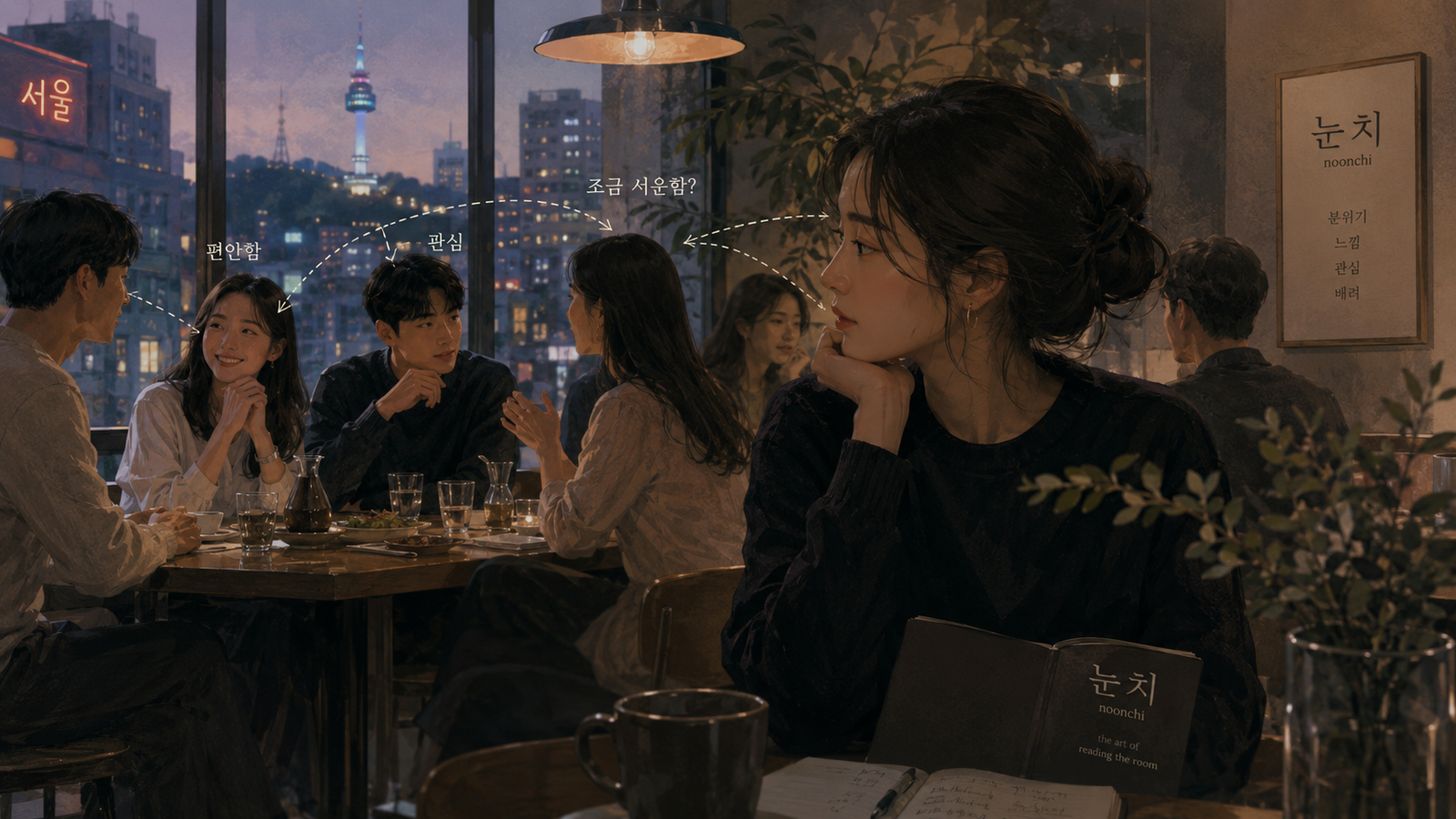
One of the most important Korean words for understanding Korean social life is also one of the hardest to translate.
눈치 — noonchi, more commonly romanized as nunchi.
It is often translated as “reading the room,” “social awareness,” or even “emotional intelligence.” All of these are partly correct, but none completely captures it.
Noonchi is the ability to sense the atmosphere around you, understand what other people are communicating without explicitly saying it, recognize your position within a social situation, and adjust accordingly.
It is not simply noticing that someone looks unhappy.
It is noticing that someone has become quieter, remembering what happened five minutes earlier, understanding the relationship between the people at the table, recognizing who has authority, considering what would be embarrassing for someone to say directly, and realizing that perhaps the conversation should move somewhere else.
Much of Korean communication exists in this space.
And for foreigners trying to understand Korea, learning noonchi can sometimes be more useful than learning another hundred vocabulary words.
Communication Beyond Words
Western communication—particularly North American communication—places enormous value on explicitness.
If you want something, say it.
If you dislike something, say it.
If someone wants to know what you mean, they can ask.
This system has advantages. Explicit communication reduces ambiguity and places responsibility on the speaker to communicate clearly.
Korean communication often distributes that responsibility differently.
The speaker communicates part of the message.
The listener is expected to understand the rest.
This does not mean Koreans are incapable of direct communication, nor does it mean every Korean interaction operates through mysterious hidden codes. But Korean culture traditionally places greater importance on context, relationships, hierarchy and preserving social harmony.
The result is a communication system in which what was not said may sometimes matter almost as much as what was said.
Noonchi is the skill used to navigate that system.
The Person With Fast Noonchi
Koreans sometimes describe someone as having 빠른 눈치 — fast noonchi.
This person quickly understands what is happening.
Imagine several coworkers having dinner with their boss. The boss looks at the time twice but does not announce that dinner is finished.
Someone with fast noonchi may recognize the signal and begin helping bring the gathering toward a natural conclusion.
Nobody needed to say:
“I want everyone to leave now.”
The situation communicated it.
Someone with poor noonchi might continue ordering drinks and enthusiastically suggesting another round.
Neither person necessarily lacks intelligence.
They are simply processing different kinds of information.
Noonchi is therefore better understood as a form of contextual social intelligence.
Reading the Entire Room
A common misunderstanding is to reduce noonchi to reading facial expressions.
Facial expressions are only one source of information.
Noonchi involves observing the whole environment.
Who is speaking?
Who is unusually silent?
Who is older?
Who has higher status?
Who knows whom?
Did the atmosphere change when a particular subject appeared?
Was an invitation enthusiastic or merely polite?
Did someone answer the actual question, or carefully move around it?
Did their words say yes while their behavior said maybe?
Did the group laugh because something was genuinely funny, or because laughter was socially appropriate?
No individual signal necessarily means much.
Noonchi comes from assembling them.
It is social pattern recognition.
Why Korea Developed Such a Strong Culture of Noonchi
Noonchi makes more sense when viewed within Korea’s historical social structure.
Confucian influence placed enormous emphasis on relationships and roles: elder and younger, teacher and student, parent and child, senior and junior.
People were rarely interacting simply as two completely independent individuals.
Relationships carried expectations.
Language itself reflects this. Korean speech changes according to social distance, familiarity and hierarchy. Before speaking, a Korean may already be processing information that an English speaker normally does not need to consider grammatically.
How old is this person?
How close are we?
What level of speech is appropriate?
What is their position relative to mine?
That sensitivity extends beyond grammar.
Korean social life consequently developed strong mechanisms for understanding relationships without constantly forcing everything into explicit negotiation.
Noonchi became part of the machinery that keeps those interactions moving.
Noonchi and Indirect Communication
Consider a simple invitation.
Someone says:
“We should eat together sometime.”
In English, this could mean almost anything—from a sincere invitation to meaningless politeness.
The words alone cannot tell you.
The same is true in Korean.
But someone using noonchi looks beyond the sentence.
Do they later suggest a restaurant?
Do they mention a particular day?
Do they bring the idea up again?
Does their energy increase when the subject appears?
Or does the invitation disappear forever?
The mistake is treating the literal sentence as the complete communication.
Noonchi asks:
What is the pattern surrounding the sentence?
This becomes particularly important in friendships and dating.
A person may test interest indirectly rather than creating the pressure of a dramatic declaration.
Someone might repeatedly mention a place they want to visit.
They might ask whether you have plans this weekend.
They might introduce a hypothetical question about relationships.
They might find reasons to remain near you.
None of these independently proves romantic interest.
But noonchi does not operate by taking isolated behaviors and declaring them proof.
It reads clusters of behavior within context.
That distinction is important.
Indirectness Is Not Necessarily Dishonesty
People raised in highly direct cultures sometimes interpret indirect communication as evasive.
Why not simply say what you mean?
Because directness has costs too.
Suppose someone wants to know whether another person is romantically interested.
Asking directly may produce clarity.
It may also create embarrassment, pressure the other person into answering immediately, change the relationship, or cause someone to lose face.
Indirect communication provides an alternative.
A person can move slightly closer socially and observe what happens.
If the other person reciprocates, the relationship can continue moving forward.
If they do not, both people can retreat without requiring a confrontation.
Ambiguity becomes a kind of social shock absorber.
Noonchi is what allows people to operate within that ambiguity.
Face and Social Harmony
This connects with another important East Asian concept: saving face.
Human beings everywhere care about embarrassment and reputation. Korea hardly has a monopoly on this.
But Korean social interaction often gives considerable importance to avoiding situations in which someone must openly acknowledge something uncomfortable.
Imagine a friend does not want to attend an event.
A direct answer might be:
“I don’t want to go.”
A more indirect response might be:
“I think I might be busy that day.”
A literal-minded listener might immediately begin solving the problem.
“What time are you busy?”
“Maybe you can come afterward.”
“We can change the date.”
Someone using noonchi may recognize that the scheduling problem is not necessarily the real message.
The message may simply be:
Please give me a graceful way to decline.
Good noonchi sometimes means knowing when not to force greater clarity.
Silence Is Information
One of the most interesting aspects of noonchi is the recognition that communication continues even when nobody is speaking.
Silence has shape.
There is comfortable silence.
Awkward silence.
Angry silence.
Embarrassed silence.
Reflective silence.
The person with noonchi notices the difference.
Likewise, an absence of enthusiasm can itself carry information.
If you suggest something three times and receive technically positive but consistently lukewarm responses, continually demanding an explicit rejection may actually demonstrate poor noonchi.
You already received information.
It simply was not delivered in sentence form.
Noonchi Is Not Mind Reading
There is also a danger in romanticizing the concept.
Having noonchi does not make someone psychic.
People misread situations.
Cultural expectations differ.
Personalities differ.
An introverted person may appear uninterested when they are simply shy. Someone may be unusually quiet because they are tired. A friendly person may appear flirtatious without intending romance.
The purpose of noonchi is not to become certain about another person’s internal state.
It is to become sensitive to probabilities and context.
Good noonchi should therefore make someone less reckless in their interpretations, not more.
Instead of saying:
“She looked at me, therefore she likes me.”
The noonchi-oriented question is:
“What does this behavior mean when considered alongside everything else happening between us?”
That is a much more sophisticated question.
Foreigners and the Noonchi Problem
Foreigners in Korea sometimes accidentally violate social expectations because they are listening primarily to words.
The Korean person may believe they have communicated something clearly.
The foreigner may believe nothing was communicated at all.
Both can walk away frustrated.
The Korean thinks:
How could they not understand?
The foreigner thinks:
Why didn’t they just tell me?
Neither communication system is inherently more intelligent.
They simply assign different responsibilities to the speaker and listener.
High-context communication expects the listener to extract more information from circumstances.
Low-context communication expects more information to be encoded explicitly in words.
Learning Korean culture therefore involves more than vocabulary and grammar.
It involves learning where the information is located.
The Dark Side of Noonchi
Noonchi is not always positive.
A society that heavily rewards reading the room can create anxiety about what other people think.
People can become excessively self-conscious.
Instead of asking:
“What do I actually want?”
someone can become trapped asking:
“How am I supposed to behave here?”
Hierarchy can amplify this problem.
An employee with excellent noonchi may become skilled at anticipating a superior’s desires before they are spoken. That can create remarkably smooth teamwork.
It can also produce environments where nobody challenges bad ideas because everyone understands what answer the senior person wants.
Social sensitivity becomes conformity.
There is therefore an important distinction between possessing noonchi and being controlled by noonchi.
The healthiest version allows you to understand the room without surrendering yourself to it.
Noonchi in the Age of Social Media
Noonchi may actually be becoming more valuable in the digital age.
Online communication strips away enormous amounts of context.
Tone disappears.
Body language disappears.
Timing becomes ambiguous.
A joke written in a message can look serious. A delayed response can mean anger, work, sleep, distraction or absolutely nothing.
Ironically, while technology gives us more ways to communicate, it can give us fewer signals for understanding communication.
This encourages people to obsess over individual fragments:
Why did she use this emoji?
Why did he like this post?
Why did she watch my story?
Traditional noonchi suggests a better approach.
Stop staring at individual signals.
Look at the pattern.
Does the person consistently invest?
Do actions match words?
What happens over time?
Context beats microscopic analysis.
Noonchi Beyond Korea
The word may be Korean, but the underlying ability is universal.
Every culture has people who enter a room and instantly understand its temperature.
They know when a joke will work.
They know when someone wants to speak.
They notice the person being excluded.
They recognize when a conversation has run its course.
They understand when confidence is appropriate and when restraint is stronger.
Korea simply gave this ability a particularly important name and cultural role.
And perhaps that is what makes noonchi worth studying even outside Korea.
Modern Western culture often encourages us to express ourselves.
There is value in that.
But expression is only half of communication.
The other half is perception.
The Art of Seeing Before Acting
At its highest level, noonchi is not about becoming timid or obsessively seeking approval.
It is almost the opposite.
It is the ability to delay reaction long enough to understand what is actually happening.
Walk into the room.
Observe.
Listen.
Notice relationships.
Feel the atmosphere.
Watch what people do rather than relying entirely on what they say.
Then act.
In this sense, noonchi resembles a social form of mindfulness.
You are paying attention to reality before imposing your own interpretation upon it.
And that may be the deeper lesson behind the Korean art of noonchi.
Sometimes intelligence is demonstrated by knowing what to say.
Sometimes it is demonstrated by noticing what nobody needed to say at all.