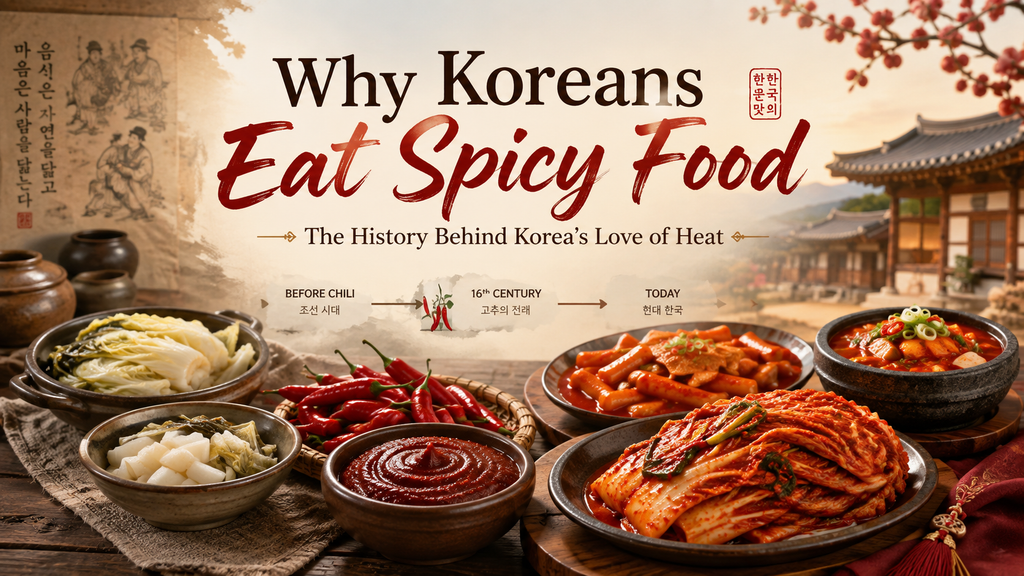
Ask someone to describe Korean food and there is a good chance the word “spicy” will appear almost immediately.
Kimchi glows red with chili flakes. Tteokbokki comes covered in a fiery sauce. Spicy ramyeon has become internationally famous. Dishes such as dakbal, jjukkumi, buldak, and spicy pork can reach levels of heat that surprise even experienced chili eaters.
Today, spiciness seems so closely connected to Korean food that it can feel ancient.
But there is an interesting historical twist:
Korean food was not always this spicy.
The bright red chili-centered cuisine that we now associate with Korea is a comparatively recent development. Korea had thousands of years of food culture before chili peppers ever arrived on the peninsula.
So how did Korea become one of the world’s great spicy-food cultures?
The answer involves trade, fermentation, agriculture, poverty, war, urbanization—and eventually an almost emotional relationship between Koreans and spicy food.
Korea Before Chili Peppers
For most of Korean history, there were no red chili peppers in Korea.
Chili peppers originated in the Americas and only spread throughout Europe and Asia following contact between the Old and New Worlds beginning in the late 15th century.
That means ancient Goguryeo soldiers were not sitting around eating bright-red kimchi.
Neither were people during most of the Goryeo Dynasty.
Traditional Korean food certainly had strong flavors, but cooks produced pungency using ingredients such as:
- garlic
- ginger
- green onions
- mustard
- black pepper
- aromatic herbs
- fermented soybean products
Korean cuisine was already highly developed around fermentation, salt, grains, vegetables, and preserved foods long before chili became important.
Even kimchi existed centuries before red pepper became one of its defining ingredients.
Early kimchi was generally closer to salted or fermented vegetables than the bright-red baechu kimchi familiar today.
Chili Peppers Arrive in Korea
Chili peppers began spreading through Asia after Portuguese and Spanish traders transported New World crops across international trade routes.
They probably reached Korea around the late 1500s or early 1600s, although historians continue to debate exactly how the pepper entered the peninsula.
Japan is frequently suggested as one route, particularly because this period overlaps with the Japanese invasions of Korea between 1592 and 1598. Other Asian trade networks may also have contributed to the pepper’s spread.
Whatever the exact route, chili gradually became established as a Korean agricultural crop.
And once Koreans began using it, something remarkable happened.
Instead of remaining a minor seasoning, chili became integrated into Korea’s already sophisticated fermentation culture.
Chili Meets Korean Fermentation
This combination may be the real secret behind Korea’s transformation into a spicy-food culture.
Korean cuisine already relied heavily on fermented foods such as:
doenjang — fermented soybean paste
ganjang — soy sauce
jeotgal — fermented seafood
kimchi — fermented vegetables
Chili could easily be incorporated into these existing food traditions.
Eventually, Korean cooks developed and popularized ingredients such as gochugaru, Korean red pepper flakes, and gochujang, fermented red chili paste.
This created something more complex than simply making food “hot.”
Korean chili flavors could now combine:
heat + saltiness + fermentation + sweetness + umami.
That combination became one of the signatures of Korean cooking.
Gochujang in particular illustrates the Korean approach perfectly. It is not merely chili sauce. Traditional gochujang combines red pepper powder with ingredients such as fermented soybean powder, rice or another starch, and salt, then allows fermentation to transform the mixture.
The result is spicy, sweet, savory, and fermented at the same time.
Kimchi Slowly Turned Red
Perhaps nothing symbolizes this transformation better than kimchi.
Foreigners sometimes assume that Korean kimchi has always looked the way it does today.
It hasn’t.
Older forms of kimchi existed without chili peppers. After peppers became available, chili was gradually incorporated into different kimchi recipes.
Over generations, red pepper became increasingly important.
The development of napa cabbage kimchi also helped produce the style of kimchi that most people now imagine when hearing the word.
Eventually, the visual identity of Korean cuisine changed.
White, pale, brown, and fermented foods increasingly shared the table with intense shades of red.
That color eventually became almost synonymous with Korean food itself.
Was Spicy Food Used to Preserve Food?
One popular explanation says Koreans began eating chili because Korea lacked refrigeration.
There is some logic behind connecting spices with food preservation, but this explanation is often exaggerated.
Koreans already had extremely sophisticated preservation methods before chili became common.
Salt, fermentation, drying, underground storage, earthenware jars, and seasonal preparation were all used.
Kimchi itself existed before chili.
Therefore, peppers did not suddenly solve Korea’s preservation problem.
A better explanation is that chili joined an existing preservation and fermentation system and proved exceptionally compatible with Korean cooking.
Rather than inventing Korean fermentation, chili transformed it.
Korea’s Climate Also Encouraged Strong Seasonal Food Traditions
Korea has traditionally experienced dramatic seasonal differences.
Winters can be extremely cold, while summers are hot and humid.
Historically, agricultural families had to preserve enough food to survive seasons when fresh produce was unavailable.
This encouraged Korea’s enormous variety of fermented foods, pickled vegetables, dried ingredients, soups, stews, and preserved seafood.
Chili fit naturally into this culinary environment.
Once people became accustomed to its taste, each generation grew up considering the flavor normal.
And food preferences learned during childhood can become extremely powerful cultural habits.
Poverty and Practical Food Also Played a Role
For much of Korean history, ordinary people were not eating royal court cuisine.
Meat could be expensive.
Rice itself could sometimes be precious.
Most people depended heavily on grains, vegetables, fermented foods, soups, and relatively inexpensive ingredients.
Strong seasonings could make relatively simple ingredients much more satisfying.
A small amount of fermented paste, garlic, chili, or salted seafood could dramatically change a bowl of vegetables, noodles, or grains.
That gave powerful seasonings practical value.
Korean cooking gradually developed an extraordinary ability to produce strong flavors using inexpensive basic ingredients.
This tradition would become particularly important during some of the most difficult periods in modern Korean history.
War Changed Korean Food
The 20th century was extraordinarily traumatic for Korea.
Japanese colonial rule lasted from 1910 until 1945.
The peninsula was then divided.
The Korean War followed from 1950 to 1953, devastating much of the country.
Food shortages were severe.
Millions of Koreans experienced displacement, poverty, and hunger.
Postwar Korean cooking consequently included many dishes built around inexpensive ingredients that could feed people cheaply.
Soups, stews, noodles, fermented sauces, and strongly seasoned dishes were practical.
One famous example is budae-jjigae, or “army base stew.”
Koreans combined foods obtained around American military bases—including Spam and sausages—with Korean ingredients such as kimchi, gochujang, garlic, and later instant noodles.
The result was intensely flavored comfort food born partly from scarcity.
What began as survival food eventually became beloved cuisine.
Industrialization Made Spicy Food Even More Important
South Korea then underwent one of the fastest economic transformations in modern history.
During the second half of the 20th century, millions of people moved from rural communities into rapidly growing cities.
Factory workers, office workers, students, and commuters increasingly needed inexpensive, satisfying meals.
Street foods expanded.
Restaurants multiplied.
Instant noodles became enormously popular.
And spicy sauces worked extremely well in this new environment.
Consider some dishes strongly associated with modern Korean life:
- tteokbokki
- spicy ramyeon
- kimchi-jjigae
- dakgalbi
- spicy pork
- spicy seafood stews
Many are flavorful, affordable, filling, easy to share, and suited to casual restaurants or street stalls.
Spicy food was no longer merely part of traditional Korean cooking.
It became part of modern urban Korean life.
The Korean Idea of “Stress Food”
There is another dimension that visitors to Korea quickly notice.
Koreans frequently associate spicy food with relieving stress.
After a difficult day, someone might deliberately order something extremely spicy.
There is even a common cultural association between being stressed and craving spicy dishes.
Physiologically, capsaicin—the chemical responsible for chili heat—stimulates pain receptors. The body can respond by releasing endorphins and creating sensations that some people find pleasurable.
But there is also a cultural element.
Eating something painfully spicy can feel cathartic.
You sweat.
Your face turns red.
Your nose runs.
For several minutes, you cannot think about much except the food.
For people living in an intensely competitive society known for long work hours, educational pressure, and fast-paced city life, spicy food has developed an almost ritualized role as emotional release.
The phrase “I need something spicy” can sometimes mean more than simply wanting a particular flavor.
It can almost mean:
“I had a rough day.”
Korea Eventually Started Chasing Extreme Heat
Once spicy food became culturally established, another phenomenon appeared:
spiciness itself became entertainment.
Restaurants began advertising exceptionally hot dishes.
Friends challenged each other.
Companies produced increasingly spicy instant noodles.
The most internationally famous example is Samyang’s Buldak Bokkeum Myeon, often called “fire noodles.”
Buldak products helped transform Korean spicy-food culture into a global internet phenomenon.
People who had never visited Korea began filming themselves attempting Korean spicy noodle challenges.
Ironically, a pepper that arrived in Korea from the Americas centuries ago had now been transformed into something distinctly Korean and exported back around the world.
Not All Korean Food Is Spicy
There is also an important misconception worth correcting.
Korean cuisine is not simply spicy cuisine.
Many famous Korean dishes contain little or no chili.
Examples include:
bulgogi
galbi
japchae
samgyetang
seolleongtang
gimbap
jajangmyeon
mandu
many varieties of jeon
numerous traditional soups and broths
Korean cooking contains enormous variation.
Sweetness, fermentation, garlic, sesame oil, soy sauce, seafood, soybean paste, grilled flavors, and subtle broths can be just as important as chili.
The international popularity of kimchi, tteokbokki, and spicy noodles can therefore exaggerate how spicy the average Korean meal actually is.
The Korean Flavor Is More Than Heat
This may ultimately explain why Korean spicy food became so successful.
The goal usually isn’t simply to create pain.
Korean cuisine became exceptionally good at combining heat with other sensations.
Gochujang can be simultaneously spicy and sweet.
Kimchi can be spicy, sour, salty, refreshing, and fermented.
Tteokbokki combines heat with sweetness and chewy texture.
Kimchi-jjigae combines acidity, fermentation, fat, garlic, chili, and umami.
The pepper is rarely acting alone.
It belongs to a larger flavor system.
A Foreign Ingredient That Became Completely Korean
There is something fascinating about the history of chili in Korea.
The chili pepper isn’t originally Korean.
Neither is it originally Asian.
Yet Korea adopted it so thoroughly that today red chili seems almost inseparable from the country’s culinary identity.
That is actually a recurring feature of culture.
Traditions are not always ancient and unchanged.
Sometimes a foreign ingredient arrives, interacts with an existing culture, and eventually creates something completely new.
Korea already possessed fermentation, kimchi, soybean pastes, preserved vegetables, strong garlic flavors, and communal food traditions.
The chili pepper entered that system.
Koreans transformed it.
And after several centuries of experimentation, the result became one of the most recognizable cuisines on Earth.
So the next time you see a bubbling red pot of tteokbokki or kimchi-jjigae, remember:
The fiery red image of Korean food isn’t something that goes back thousands of years.
It is the product of Korea continuously reinventing its cuisine.
And perhaps that is a very Korean story in itself.