

There is a particular kind of social lesson you can only learn in Korea by sitting at a table long enough.
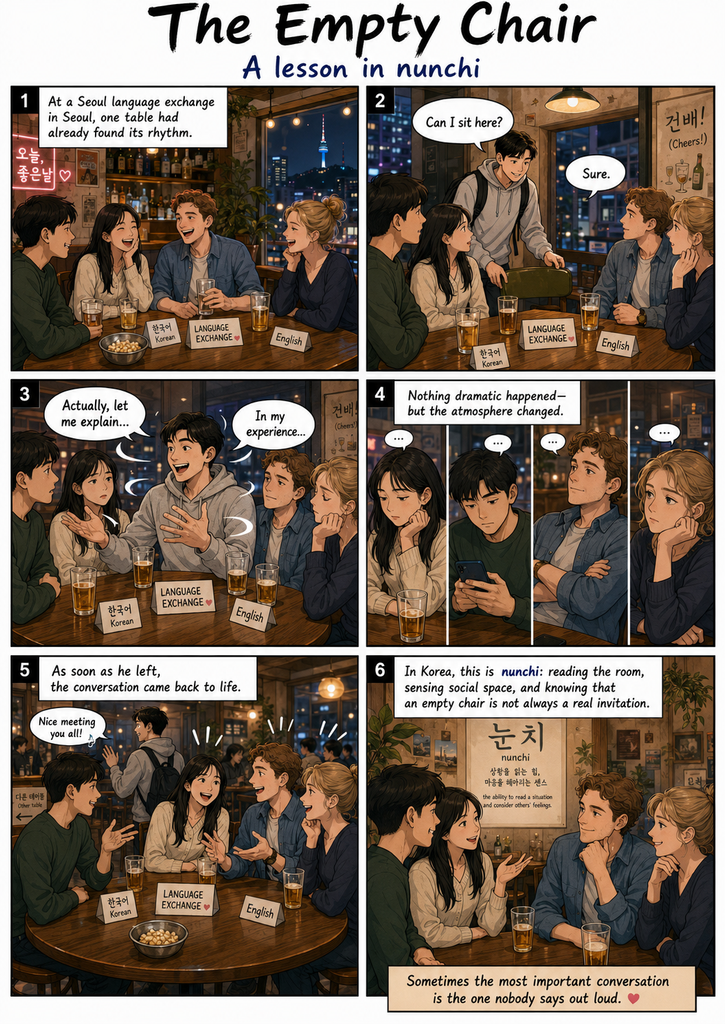
It happened one evening at a language exchange in Seoul.
The event itself was typical of dozens of gatherings around the city. Koreans came to practice English. Foreigners came to practice Korean, meet people, or simply have somewhere social to go after work. Some people were regulars who had known each other for months. Others were newcomers wandering from table to table trying to find their place.
At my table were several people I already knew.
The conversation had developed naturally. Nobody had formally decided who belonged there. We simply ended up sitting together, joking, switching between Korean and English, and talking about our lives.
Then a man I’ll call Daniel appeared.
There was an unused chair nearby.
Daniel pulled it over.
“Can I sit here?”
Technically, there was no reason he couldn’t.
It was a public language exchange. Nobody owned the table. Nobody had reserved the chair.
So somebody politely said yes.
Daniel sat down.
Within a few minutes, however, the atmosphere changed.
He interrupted people. He corrected things that didn’t need correcting. When somebody mentioned their job, he immediately explained why his own experience was more impressive. When someone made a joke, he redirected the conversation toward himself.
Nothing he did was outrageous.
That was what made the situation interesting.
There was no single moment where somebody could reasonably stand up and say, “You are behaving badly.”
Instead, the table simply became less comfortable.
One woman became quieter.
Another person started looking at his phone.
Someone who had previously been leaning into the conversation physically leaned backward.
The energy had changed.
And Daniel seemed completely unaware of it.
Welcome to the World of Nunchi
Foreigners learning about Korean culture eventually encounter the word nunchi (눈치).
It is often translated as “reading the room.”
That translation is accurate, but incomplete.
Nunchi is the ability to notice the invisible social information circulating between people.
Who is comfortable?
Who wants to speak?
Who wants to leave?
Who is closer to whom?
Has somebody become annoyed even though they are smiling?
Is an invitation sincere, or merely polite?
Is your presence improving the atmosphere—or quietly making everyone uncomfortable?
Nobody announces these things.
You are expected to notice them.
That evening, Daniel understood the literal rules of the event perfectly.
There was an empty chair.
It was a public meetup.
Someone said he could sit down.
Therefore, in his mind, he belonged at the table.
But socially, something more complicated was happening.
He had entered an already-established rhythm without noticing it.
In Korea, “Yes” Does Not Always Mean Enthusiasm
This can confuse foreigners.
In highly individualistic cultures, communication is often interpreted literally.
“Can I sit here?”
“Sure.”
End of story.
But Korean social communication frequently contains another layer.
People may say yes because saying no would create unnecessary awkwardness.
They may smile because openly displaying irritation would damage the atmosphere.
They may continue behaving politely even when they would prefer someone to leave.
This does not mean Koreans are being dishonest.
It reflects a cultural preference for allowing people to preserve dignity.
Instead of forcing someone out of a social situation, the group often gives that person an opportunity to notice the atmosphere themselves.
Nunchi completes the communication.
The words say:
“Sure, sit down.”
The room might simultaneously be saying:
“Please don’t dominate this conversation.”
A socially skilled person notices both messages.
The Invisible Architecture of a Korean Table
One thing I have noticed after spending time at Korean social gatherings is that tables develop their own personalities.
One table might be energetic and loud.
Another might be mostly Korean conversation.
Another might contain longtime friends.
Another might be full of newcomers.
The seating arrangement itself can become a temporary social ecosystem.
This is especially noticeable at language exchanges.
They appear completely open from the outside.
Anyone can attend.
But inside the event are dozens of smaller relationships.
Friendships.
Acquaintances.
People who quietly like each other.
People avoiding each other.
People who always sit together.
People who have history nobody else knows about.
The official structure says everyone is equal.
The social structure is much more complicated.
You don’t need to understand every relationship.
But nunchi means recognizing that those relationships exist.
When Confidence Becomes Social Blindness
Daniel was confident.
Normally, confidence is treated as a positive characteristic.
But confidence without nunchi can become exhausting.
He spoke loudly.
He took conversational space without hesitation.
He challenged people unnecessarily.
He seemed determined to establish himself quickly.
Perhaps he believed he was being charismatic.
Yet charisma is not simply the ability to command attention.
Real social intelligence also involves knowing when not to command attention.
Sometimes the most socially powerful person at a Korean table is the person speaking the least.
They notice who has been interrupted.
They ask the quiet person a question.
They recognize when a joke went slightly too far.
They sense when the group wants to change topics.
They understand that social status does not always need to be announced.
This is where Korean concepts such as nunchi can offer something valuable even outside Korea.
Nobody Asked Him to Leave
Eventually, Daniel moved somewhere else.
Nobody confronted him.
Nobody created an argument.
There was no dramatic ending.
But almost immediately, the original conversation returned.
People leaned toward the table again.
Someone laughed.
The woman who had become quiet started talking.
The atmosphere repaired itself.
I remember thinking how strange it was that nothing obvious had happened, yet everyone seemed to feel the same change.
That may be one of the most important things foreigners can learn about social life in Korea:
Not everything important is spoken.
Sometimes the real conversation is happening underneath the conversation.
Nunchi Is Not Mind Reading
There is also a danger in romanticizing the concept.
Nunchi does not mean constantly worrying about what everybody thinks.
Nor does it mean Koreans possess some mystical ability to understand one another.
Koreans misread situations too.
Some people have excellent nunchi.
Some have terrible nunchi.
The word itself proves that Korean society recognizes social awareness as a skill precisely because people vary in how good they are at it.
The goal is not paranoia.
It is awareness.
You observe before imposing yourself.
You notice how people respond.
You adjust.
And sometimes you recognize that an empty chair is not necessarily an invitation.
What Korea Taught Me About Social Space
Western advice about socializing often emphasizes confidence.
Introduce yourself.
Join the group.
Speak up.
Take initiative.
Korean culture adds another lesson:
Pay attention to what already exists before entering it.
A room has an atmosphere before you arrive.
A conversation has a rhythm before you speak.
A group has relationships before you join it.
Learning to see those invisible structures may be one of the most useful cultural lessons Korea has given me.
Because sometimes social intelligence isn’t knowing what to say.
Sometimes it’s noticing that nobody needed you to say anything at all.