There are few countries where a school exam can change airline schedules, delay the opening of the stock market, alter commuting hours, mobilize police motorcycles and prompt thousands of parents to spend the day praying in temples and churches.
In South Korea, that day is Suneung Day.
Known formally as the College Scholastic Ability Test (CSAT), or Daehak Suhak Neungnyeok Siheom (대학수학능력시험), the Suneung (수능) is South Korea’s national university entrance examination. For hundreds of thousands of young Koreans, it represents the culmination of years of studying, private academies, mock examinations, late nights and enormous expectations.
But Suneung is more than an exam.
For one day each November, it becomes a national ritual.
What Is Suneung?
Suneung is the standardized examination used as a major component of university admissions in South Korea. Although Korean universities can consider several factors when selecting students, Suneung scores can have enormous influence—particularly for admission through the exam-focused jeongsi route and for highly competitive universities.
The test covers areas including Korean, mathematics, English, Korean history, inquiry subjects and, depending on the student’s choices, a second foreign language or Classical Chinese.
It is an extraordinarily long examination day. Recent versions have begun at roughly 8:40 in the morning and continued into late afternoon, depending on which optional sections a student takes.
The 2027 academic-year Suneung—the examination being held in 2026—is officially scheduled for Thursday, November 19, 2026, with score reports scheduled for December 11.
The Remarkable Part: The Country Adjusts to the Students
Perhaps nothing demonstrates the cultural importance of Suneung better than what happens outside the examination rooms.
Instead of expecting students simply to cope with normal society around them, South Korean society partially reorganizes itself around the examination.
Government offices and participating workplaces have traditionally been asked to begin later so that morning commuters do not clog roads while students are travelling to testing centres. Additional subway services are operated, buses may run more frequently, and emergency transportation is positioned to assist students.
And then there are the police.
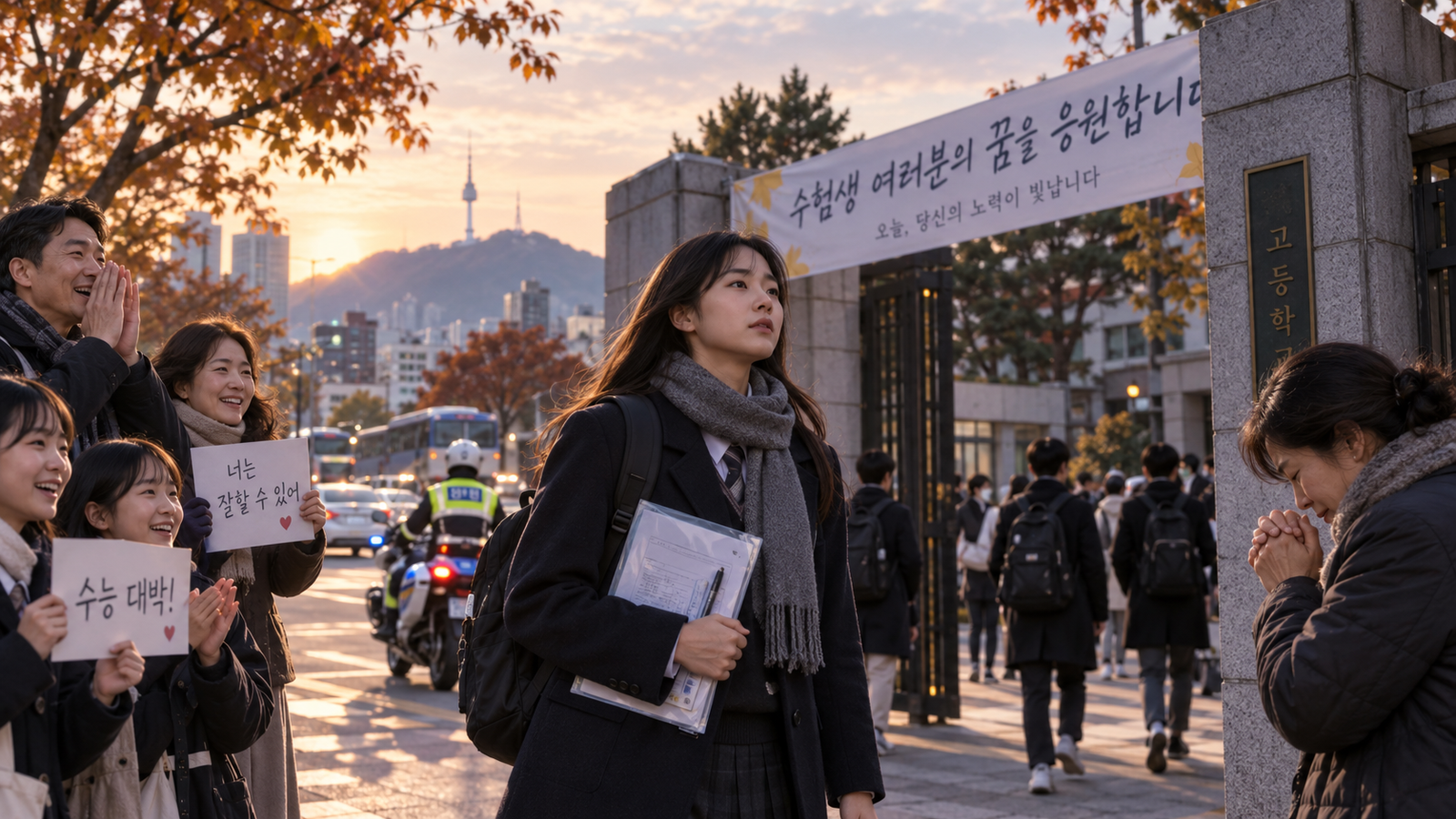
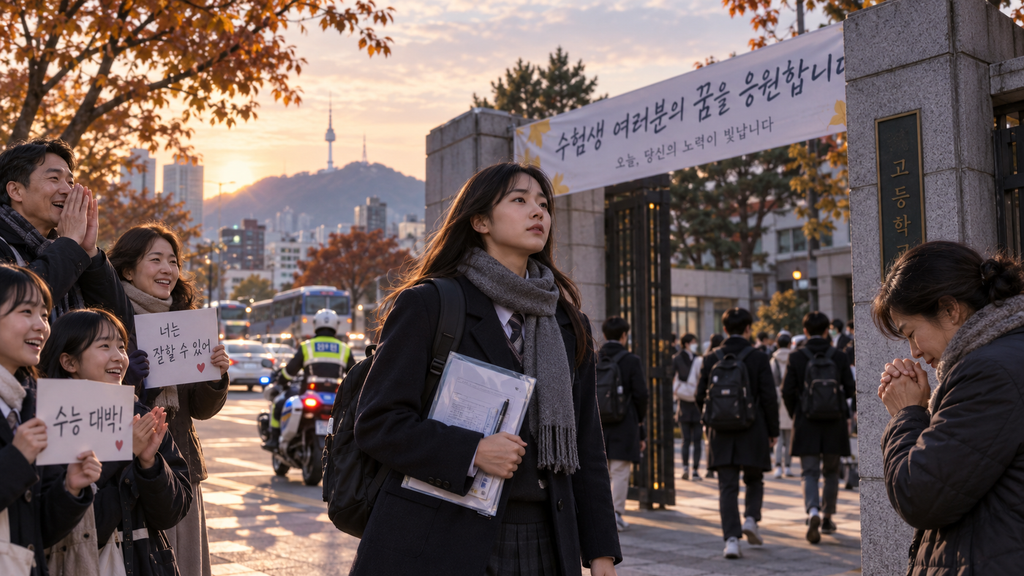
One of the most recognizable Suneung Day images is a late-running teenager being hurried toward an examination centre on the back of a police motorcycle or inside a patrol car. Police and municipal authorities have repeatedly provided emergency transportation for students who risk missing the examination.
Imagine telling a police officer in another country:
“I’m late for my university entrance exam.”
In Korea, that can become a legitimate national emergency.
Even Airplanes Have to Be Quiet
Then comes perhaps the most famous Suneung tradition.
During the English listening examination, aircraft operations are restricted across South Korea so that airplane noise does not interfere with students listening to their test recordings.
In 2025, for example, takeoffs and landings were halted nationwide for 35 minutes, while aircraft already in flight were required to remain at least three kilometres above the ground except in emergencies. The schedules of 140 flights were adjusted around the examination.
Military exercises involving artillery and tanks can also be suspended during the listening period, while noise around examination sites is controlled.
It is difficult to think of a stronger symbol of the importance Korea places on education:
For a few minutes, even the airplanes must wait for the students.
Even the Stock Market Starts Late
Suneung reaches areas of society seemingly unrelated to education.
South Korea’s financial markets have traditionally altered their schedules on examination day. In 2025, for example, the KOSPI, KOSDAQ and KONEX opened at 10:00 a.m. instead of 9:00 a.m. and closed an hour later.
The reason was not financial.
It was traffic.
Delaying the morning commute of financial-sector employees helps reduce congestion while students travel to their examination sites.
That makes Suneung one of the rare educational events capable of literally moving the operating hours of a national stock exchange.
The Night Before Suneung
The emotional atmosphere begins long before the students sit down.
Parents, grandparents and relatives commonly pray for students at Buddhist temples, Christian churches and other religious sites.
Jogyesa, one of Seoul’s best-known Buddhist temples, has become particularly associated with images of parents praying for children taking the examination. Churches likewise hold special prayer services.
For many families, Suneung is therefore not merely academic.
It becomes spiritual.
After years of preparation, there comes a point when parents can no longer study on behalf of their children. Prayer becomes one of the few things left that they feel they can do.
Why Students Receive Sticky Food
Suneung also has its own collection of good-luck traditions.
One of the classic gifts is yeot (엿), a traditional sticky Korean confection. Sticky rice cakes, or tteok, are also common.
The symbolism comes from the idea that the student should “stick” to the university they are applying to—in other words, successfully gain admission. Sticky foods therefore became symbols of successfully “sticking” the exam or university entrance.
Chocolate, snacks, encouraging notes and increasingly elaborate commercial Suneung gift packages have joined the older traditions.
A common message is:
수능 대박! — Suneung daebak!
Essentially: Do amazingly well on the Suneung.
The expression has become so closely associated with the exam that it appears on everything from banners to gift boxes.
The Morning Outside the School
Traditionally, another memorable scene has taken place outside testing centres.
Younger students, teachers, friends and relatives gather around the school entrances, cheering students as they arrive.
There can be signs, chanting, hugs and last-minute encouragement before the examinees disappear through the gates.
Then the doors close.
For the students inside, years of preparation suddenly come down to several hours.
For everyone outside, there is nothing left to do but wait.
Why Is One Examination So Important?
To understand Suneung, one has to understand the historical importance placed on education in Korea.
Education has long carried enormous social prestige in Korean society. The older Confucian examination culture of East Asia associated learning with advancement, status and entry into elite administrative life.
Modern Korea transformed that educational drive into something new.
During South Korea’s rapid economic development, university education became one of the principal routes into professional careers and the expanding middle class. Competition intensified, particularly for admission to prestigious universities.
At the top sit institutions commonly grouped under the acronym SKY:
Seoul National University, Korea University and Yonsei University.
For generations of Koreans, university name recognition could influence employment opportunities, professional networks and social status.
That helps explain why Suneung can feel far more consequential than an ordinary school examination.
The Hagwon World Behind Suneung
Suneung Day is merely the visible climax of a much larger education industry.
Long before November, many Korean students spend their evenings attending hagwons—private educational academies—after finishing their regular school day.
Entire neighbourhoods are famous for education businesses. Seoul’s Daechi-dong, for example, has become synonymous with elite private education.
Students take practice Suneung examinations, study previous questions, watch famous instructors and sometimes structure years of their teenage lives around university admissions.
This is where the impressive side of Korea’s education culture collides with its darker side.
Discipline and academic ambition can produce extraordinary results.
But the pressure can also become enormous.
The Darker Side of Suneung Culture
The romantic image of a country becoming quiet for its students should not hide the psychological burden the system can create.
When teenagers begin to believe that several hours of performance will determine the quality of the rest of their lives, ordinary academic anxiety can become something considerably heavier.
The enormous Korean private-education market exists partly because families fear that failing to participate will leave their children behind.
And because prestigious universities remain powerful social signals, relatively small differences in academic performance can feel disproportionately important.
Korea itself continues to debate this problem: how to preserve high educational standards without allowing education to dominate childhood.
Suneung therefore represents two sides of modern Korea simultaneously.
It demonstrates Korea’s extraordinary respect for education, preparation and collective responsibility.
But it also exposes the country’s intense competition, credentialism and fear of falling behind.
What Happens When Suneung Is Finished?
For many students, the moment after the examination is surreal.
A routine that has dominated their lives for months—or years—is suddenly finished.
Restaurants, entertainment districts and shopping areas can fill with teenagers finally enjoying a degree of freedom. Families celebrate. Students compare answers, worry about scores or simply try not to think about the examination anymore.
Universities still have admission procedures ahead, and some students face interviews or additional assessments.
Others may decide to take Suneung again the following year.
Students who repeat the examination are known as jaesusaeng (재수생), and retaking Suneung is common enough to be a recognizable phase of Korean student life.
Suneung as a Korean Rite of Passage
Perhaps the best way for a foreigner to understand Suneung is not simply as Korea’s version of the SAT.
Culturally, it is closer to a rite of passage.
Almost everyone in Korean society understands what the student sitting in that examination room has experienced.
Older Koreans remember their own exam.
Parents remember waiting for their children.
Teachers remember preparing their classes.
Younger students know their turn is coming.
That shared experience gives Suneung a social importance that extends far beyond its technical function as a university entrance examination.
A Day When Collective Korea Becomes Visible
Modern Seoul is famously fast.
Trains arrive every few minutes. Delivery motorcycles weave through traffic. Offices run late. Airports operate continuously. Financial markets move enormous sums of money. Construction seems almost perpetual.
Then Suneung arrives.
Offices start later.
Trains carry nervous teenagers toward schools.
Police officers wait to rescue anyone running behind.
Parents light candles and pray.
Stock traders alter their schedules.
Pilots adjust their flights.
And during the English listening examination, one of the busiest societies on Earth deliberately tries to become quiet.
There is something uniquely Korean about that image.
Suneung Day reveals both the strengths and contradictions of South Korea’s education culture: extraordinary discipline alongside extraordinary pressure, fierce individual competition surrounded by remarkable collective cooperation.
For one day, the ambitions of several hundred thousand students become everybody’s concern.
And South Korea adjusts the country around them.