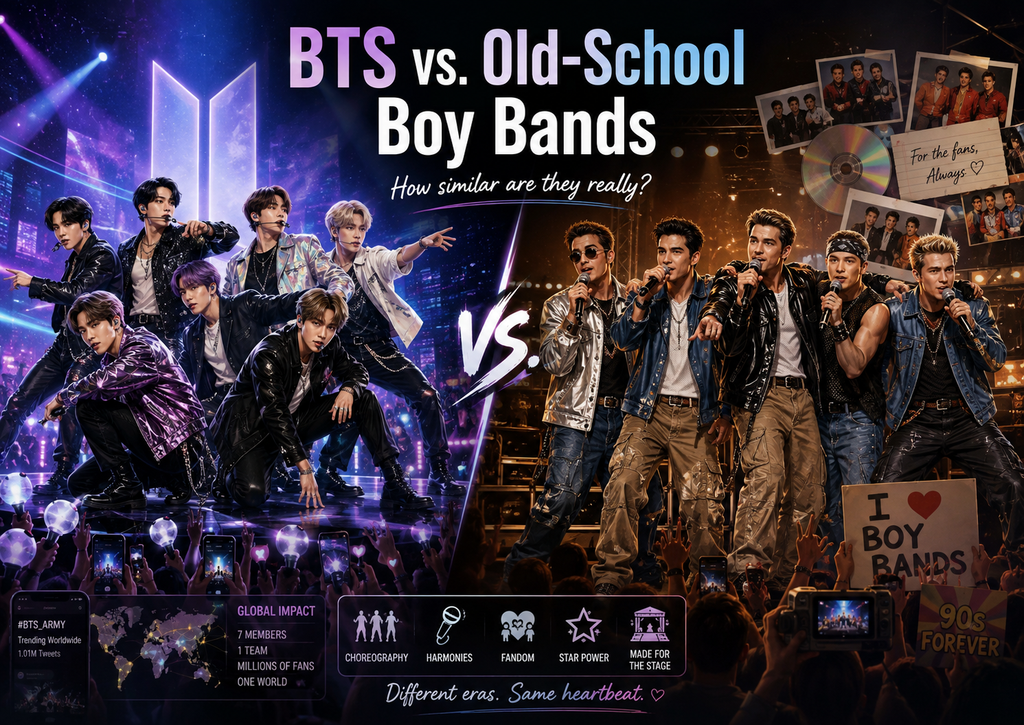
When BTS first became huge in North America, one of the easiest comparisons was obvious: “They’re basically the Korean Backstreet Boys.”
On the surface, that comparison makes sense.
Seven attractive young men. Carefully produced pop music. Elaborate choreography. Extremely dedicated female fans. Posters, merchandise, screaming crowds, coordinated outfits and enormous concert tours.
It sounds a lot like the formula that produced New Kids on the Block, Backstreet Boys and NSYNC.
But calling BTS simply a Korean version of those groups misses quite a lot. At the same time, BTS fans sometimes go too far in the opposite direction and act as though BTS has absolutely nothing in common with traditional manufactured boy bands.
The truth is somewhere in between.
First, Yes — BTS Is a Boy Band
There is sometimes resistance among K-pop fans to even calling BTS a boy band.
But descriptively, they are.
BTS consists of male performers assembled into a pop group whose appeal combines music, personality, appearance, choreography and a relationship with a predominantly passionate fanbase.
That is essentially what a boy band is.
Backstreet Boys had Nick Carter, Brian Littrell, AJ McLean, Howie Dorough and Kevin Richardson. NSYNC had Justin Timberlake, JC Chasez, Joey Fatone, Lance Bass and Chris Kirkpatrick.
Fans didn’t simply like the songs.
They had a favorite member.
That concept should sound very familiar to K-pop fans.
K-pop eventually formalized something Western teenage pop had already been doing informally for decades: creating a group in which different personalities and appearances appealed to different fans.
The shy one.
The funny one.
The handsome one.
The rebellious one.
The sensitive one.
K-pop calls this choosing a bias.
A Backstreet Boys fan in 1999 probably just said, “I like Nick.”
The psychology isn’t particularly different.
The Industrial Origins Are Also Surprisingly Similar
Another similarity fans occasionally avoid discussing is that neither Western boy bands nor K-pop idols emerged entirely organically.
The classic Western romantic idea of a band is something like four friends meeting in a garage, writing songs together and eventually getting discovered.
That wasn’t really the boy-band model.
New Kids on the Block were assembled by producer Maurice Starr.
Backstreet Boys were assembled after businessman Lou Pearlman held auditions.
NSYNC also emerged through an intentionally constructed entertainment-industry process.
K-pop agencies simply developed this idea into a much more sophisticated system.
BTS was formed under Big Hit Entertainment after trainees were recruited and developed before debut.
So the underlying concept isn’t uniquely Korean:
Find talented young performers, combine complementary personalities, train them, build an image and market the resulting group.
Korea just industrialized the system much more thoroughly.
Where K-pop Changed the Formula: Training
This is one of the biggest differences.
Western boy bands certainly rehearsed.
They learned choreography, recorded vocals, trained for performances and worked extremely hard.
But Korea created an entire trainee system around idol production.
Potential idols can spend years learning dance, vocals, stage presence, languages, media behaviour and performance skills before officially debuting.
The expectation is also broader.
A Backstreet Boy primarily needed to sing, perform and look charismatic.
A Korean idol may be expected to sing, dance complicated choreography, appear effortlessly entertaining on variety shows, livestream with fans, participate in interviews, pose for fashion campaigns and maintain an enormous amount of continuous media output.
K-pop didn’t invent the boy band.
It created something closer to the professional athlete version of the boy band.
BTS Also Has a Stronger Creative Identity
This is probably where the comparison with groups like Backstreet Boys becomes less accurate.
Backstreet Boys were exceptional pop performers, but they generally weren’t presented as an auteur-driven musical project.
Professional songwriting teams and producers created much of their catalogue.
That wasn’t necessarily a bad thing.
Songs like “I Want It That Way” are superbly constructed pop songs regardless of who wrote them.
BTS, however, developed with considerably more involvement from members in songwriting, rap and lyrical concepts.
RM, Suga and J-Hope in particular came from backgrounds much closer to hip-hop songwriting and rap culture than the stereotypical boy-band singer.
That influences how BTS functions.
There are obviously producers, composers, management decisions and commercial considerations surrounding BTS, just as there are around almost every major pop act.
But the members have participated significantly in shaping the group’s music and themes.
That makes BTS somewhat harder to compare directly with Backstreet Boys.
They occupy a strange middle territory between idol group and artist-driven pop group.
Rap Changes the Equation
Imagine adding several serious rappers to NSYNC.
The result would already be structurally different.
Traditional Western boy bands were overwhelmingly vocal groups.
Different members might sing verses or harmonies, but the musical structure generally remained conventional pop.
BTS developed around both a vocal line and rap line.
That allowed their catalogue to move between pop, hip-hop, R&B, EDM and more experimental combinations of genres without completely abandoning the group’s identity.
It also gave BTS members more distinct musical roles.
The distinction isn’t simply:
“Which handsome guy do you like?”
It can also be:
“Which musical style within BTS do you prefer?”
That gives the group considerably more artistic flexibility than many 1990s boy bands had.
But the Fan Psychology Is Very Old School
For all the differences, watching BTS fandom can sometimes feel remarkably similar to watching Beatlemania or the Backstreet Boys phenomenon with modern technology added.
Fans collect photographs.
They know members’ birthdays.
They follow hairstyles.
They analyze relationships between members.
They memorize interviews.
They defend the group passionately against criticism.
They travel internationally for concerts.
They form enormous communities around their shared interest.
None of this started with K-pop.
What changed is the internet.
A Backstreet Boys fan in 1998 might receive an interview once a month in a magazine.
A BTS fan can watch hours upon hours of content involving the members.
That dramatically increases what psychologists sometimes call a parasocial relationship — the feeling that you know a celebrity personally despite the relationship being largely one-sided.
K-pop agencies are extremely good at nurturing this connection.
Social Media May Be BTS’s Biggest Historical Advantage
BTS also arrived at almost the perfect moment.
Backstreet Boys and NSYNC existed during the MTV era.
Television executives, radio programmers and record labels acted as gatekeepers.
International artists had difficulty entering the American market unless those institutions supported them.
BTS emerged during the YouTube, Twitter and streaming era.
Suddenly a teenager in Canada could discover Korean music without a Canadian radio station ever playing it.
Fans themselves could translate interviews, circulate performances, create memes, organize streaming campaigns and introduce friends to the group.
ARMY therefore became part of the distribution network.
That is historically important.
BTS didn’t merely become successful because a Western record executive decided Americans should listen to Korean pop.
Their international audience helped force traditional media to pay attention.
BTS Also Carries Korea With Them
This may be the biggest cultural distinction between BTS and something like NSYNC.
Nobody listened to NSYNC and suddenly became fascinated with American culture.
America was already culturally dominant.
BTS arrived internationally as representatives — intentionally or not — of a country many Western listeners knew relatively little about.
Someone discovering BTS might eventually become interested in Korean food, Korean television, Korean language, Korean cosmetics, Korean fashion or eventually Korea itself.
That gives BTS a kind of cultural role that Western boy bands rarely possessed.
They became part of the larger Hallyu, or Korean Wave.
For South Korea, an entertainment act becoming internationally famous isn’t merely another successful band.
It contributes to the country’s cultural influence.
K-pop Visuals Are on Another Level
Another area where K-pop clearly evolved the old boy-band model is visual presentation.
Watch an NSYNC video from around 2000.
Then watch a major modern K-pop production.
The difference is enormous.
Of course, technology improved during those decades.
But K-pop also treats the visual element of pop music almost as seriously as the music itself.
Music videos contain elaborate sets, fashion concepts, choreography, symbolism and cinematography.
Every comeback can introduce an entirely new visual identity.
Hair changes.
Fashion changes.
Album concepts change.
Promotional photographs change.
Even the terminology is revealing.
Western artists release an album.
K-pop idols have a comeback.
It feels more like the launch of a new season of a television show.
K-pop Also Demands More Perfection
There is a darker side to that professionalism.
The idol system can place extraordinary expectations on performers.
Appearance matters intensely.
Weight matters.
Behaviour matters.
Dating can become controversial.
A poorly interpreted comment can create a scandal.
Fans sometimes expect idols to maintain an almost impossible public persona.
Western boy bands certainly experienced image management as well.
Their managers understood perfectly well that millions of teenage fans preferred imagining members as romantically available.
But modern K-pop fandom combined that old marketing instinct with social media surveillance.
Every photograph can become evidence.
Every interaction can be analyzed.
Every mistake can circulate globally within hours.
BTS benefited enormously from the machinery of K-pop while also having to live inside its pressures.
BTS Members Also Became Stronger Individual Artists
There is another interesting comparison with NSYNC.
NSYNC eventually produced one enormous individual star: Justin Timberlake.
Once Timberlake’s solo career exploded, the logic of keeping NSYNC together became increasingly difficult.
Historically, this happens frequently with groups.
One member becomes disproportionately famous and eventually eclipses everyone else.
BTS has taken a somewhat different route.
Individual members have developed solo identities while the BTS brand itself remains extremely powerful.
And because different members occupy different musical niches, their solo projects don’t necessarily compete directly with one another.
One member can explore rap.
Another can pursue polished pop.
Another can move toward R&B or experimental music.
The BTS ecosystem can therefore support several individual careers without requiring one obvious “Justin Timberlake” to emerge.
Are BTS Better Than Backstreet Boys or NSYNC?
That’s where the comparison becomes subjective.
If someone prefers tightly constructed late-1990s pop melodies, Backstreet Boys have songs that remain extraordinarily effective decades later.
If someone values difficult choreography, concept-driven performances and genre experimentation, modern K-pop has an obvious advantage.
If songwriting participation matters, BTS has a stronger argument for artistic authorship than many traditional boy bands.
If vocal harmony is the priority, some older Western vocal groups were exceptionally strong.
Different eras optimized for different things.
There is no serious reason to pretend one generation was objectively superior at everything.
The Most Accurate Description of BTS
BTS didn’t destroy the Western boy-band formula.
They evolved it.
Take the fan attachment of New Kids on the Block.
Add the polished pop machinery of Backstreet Boys.
Add the choreography of NSYNC.
Mix in Korean idol training.
Add hip-hop.
Add elaborate visual storytelling.
Add constant social-media interaction.
Add YouTube and global streaming.
Then place the entire phenomenon inside the rise of Korean cultural influence.
You start getting something that resembles BTS.
That is why dismissing BTS as “just another boy band” is too simplistic.
But claiming BTS has nothing whatsoever in common with the manufactured Western boy bands of previous generations is equally unrealistic.
They belong to the same entertainment lineage.
The fascinating part is seeing how much the formula changed when South Korea took it, professionalized it and eventually exported it back to the West.