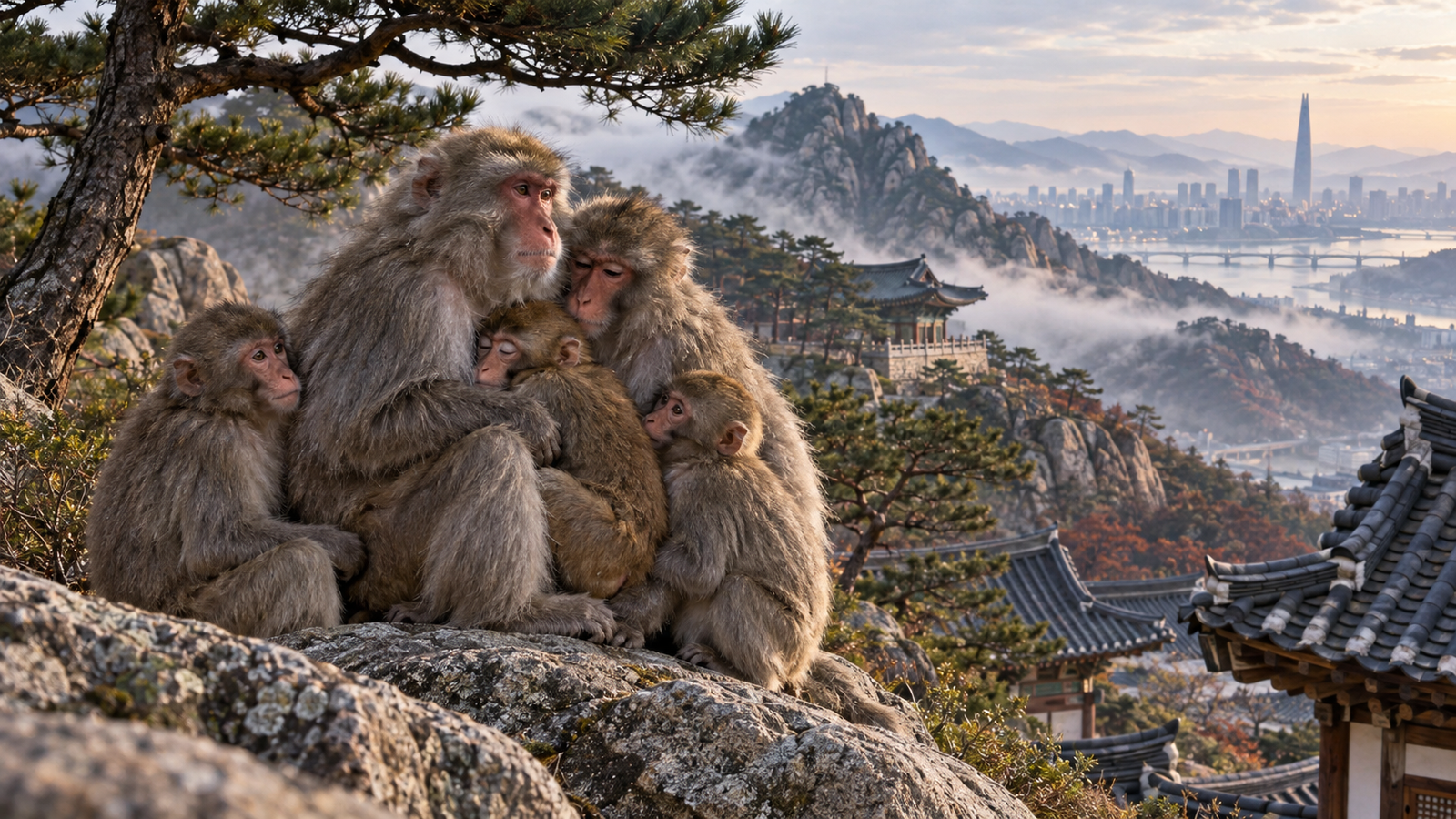
Thousands of years before Seoul existed, before Confucianism arrived in Korea and before there was anything recognizable as Korean civilization, monkeys lived on the Korean Peninsula.
Not metaphorical monkeys.
Actual macaques.
Fossils discovered in Korea reveal that the peninsula once supported populations of macaques closely related to species that still survive elsewhere in East Asia today. One fossil macaque discovered at the Durubong Cave Complex in South Korea was found to resemble the modern Japanese macaque remarkably closely. Researchers concluded that close relatives of today’s Macaca fuscata once lived naturally on the Korean Peninsula. (CiNii)
That fact creates an intriguing cultural thought experiment.
Modern Korea is famous for being a highly group-conscious society. Relationships, hierarchy, belonging and awareness of one’s position within a social environment traditionally matter enormously.
Macaques, interestingly, organize much of their lives around remarkably sophisticated versions of those same basic social principles.
This does not mean Korean culture somehow descended from monkey behavior.
There is no scientific evidence for such an idea.
But it does give us a surprisingly interesting parallel between two very different kinds of social systems that have existed on the same peninsula.
The Monkeys That Once Lived in Korea
One of the most significant Korean macaque discoveries comes from the Durubong Cave Complex in North Chungcheong Province.
Researchers examined fossil facial remains belonging to a macaque classified as Macaca cf. robusta.
When its anatomy was compared with living macaque species, its closest match was the Japanese macaque (Macaca fuscata), with the rhesus macaque coming second. The researchers concluded that animals closely resembling today’s Japanese macaques lived on the Korean Peninsula during the Middle-to-Late Pleistocene. (CiNii)
That is significant because modern Korea has no surviving indigenous macaque population.
At some point, changing climate, habitat and ecological conditions apparently eliminated them from the peninsula.
But their fossil remains tell us that monkeys were once part of Korea’s natural landscape.
And they may have lived in highly organized troops.
A Society Built Around the Group
Modern macaques are intensely social animals.
Rhesus macaques, for example, generally live in large multi-male, multi-female troops. Females usually remain within their birth group, forming long-lasting kinship networks involving mothers, daughters and sisters. Males are more likely to leave and enter other groups.
Within the troop, relationships are not random.
There are friendships.
There are family alliances.
There are dominance relationships.
There are individuals whose social positions differ considerably from others.
Research on rhesus macaques has found that kinship networks can contribute directly to the stability of the entire group. Stronger cohesion within family lines corresponds with more stable grooming relationships and fewer serious conflicts. (CDC Stacks)
Official guidance based on macaque behavioral research likewise describes macaques as living naturally in matriarchal multi-male, multi-female societies containing both male and female dominance hierarchies, with particularly strong bonds among related females. (GOV.UK)
In other words, a macaque does not merely exist as an isolated individual.
Its social world matters enormously.
Where Do I Stand?
That provides the first interesting comparison with traditional Korean society.
One of the defining characteristics of Korean social interaction has historically been the importance of relationship position.
Who is older?
Who entered the organization first?
Who is senior?
Who is family?
Who introduced whom?
How close are these two people?
What level of language should be used?
These are not secondary details.
They can determine how an interaction unfolds.
Traditional Korean culture has often been described as collectivist and strongly relationship-oriented, although obviously modern Koreans vary enormously and Korea itself continues to change. Cross-cultural research has repeatedly identified South Korea as relatively group-oriented compared with countries such as Canada or the United States. (Scribd)
Even the Korean language reflects relational distinctions.
Whether someone uses 존댓말 (jondaemal) or 반말 (banmal) can depend upon age, familiarity and social relationship.
A sentence cannot always be separated from the relationship between the people speaking it.
Macaque Hierarchy Is Surprisingly Complicated
Macaque hierarchy is also more complicated than simply having one big dominant monkey ordering everybody around.
Among many macaque species, females inherit much of their social position through their maternal family.
A young female may acquire status partly because her mother and other relatives support her during conflicts. Entire maternal family lines can consequently occupy different positions within the troop hierarchy. (PubMed Central (PMC))
Researchers studying rhesus macaques describe individuals as possessing distinct relationships with multiple other members of the troop, maintained through proximity, grooming and coalitionary support. (PubMed Central (PMC))
That begins to resemble something recognizable to anyone who has spent enough time in Korea.
Not because Koreans behave like macaques.
Rather, both social systems illustrate the importance of something Western individualism sometimes underestimates:
A person—or animal—can possess a social identity that exists partly through relationships with everybody around them.
The Korean Concept of the Relational Self
Western culture often encourages people to describe themselves through personal characteristics.
“I am ambitious.”
“I am creative.”
“I am independent.”
“I am successful.”
Traditional Korean identity can place comparatively greater emphasis upon relationships.
Whose son are you?
Which school did you attend?
What company do you belong to?
Which 선배 (seonbae, senior) or 후배 (hubae, junior) relationship exists between you?
Which group are you part of?
This does not mean Korean people lack individuality.
Quite the opposite.
Koreans can be extremely individualistic in personal taste, ambition and lifestyle.
But the social environment frequently remains highly relational.
The individual exists partly through relationships.
That is why the Korean word 우리 (uri), literally meaning “we” or “our,” appears in expressions that can initially sound strange to foreigners.
우리 엄마 — “our mother.”
우리 집 — “our house.”
우리 회사 — “our company.”
The linguistic instinct frequently begins with we.
Nunchi: Social Navigation
Another uniquely Korean concept makes the comparison even more interesting.
눈치 (nunchi) is often translated as “reading the room.”
But it means more than simply noticing whether someone looks unhappy.
Nunchi involves continuously observing the social environment.
Who is comfortable?
Who is annoyed?
Who wants to speak?
What is being implied rather than stated?
What does the senior person want?
What is the emotional atmosphere of the group?
When should I speak?
When should I remain quiet?
Good nunchi therefore requires a person to maintain a kind of constantly updated social map.
And that is something highly social primates also must do, although obviously on a vastly simpler level.
A macaque must understand who dominates whom.
It must remember allies.
It must recognize relatives.
It must know which individuals are safe to approach.
It must interpret grooming, threats, reconciliation and coalitionary behavior.
For both systems, social intelligence requires knowing more than what is happening directly in front of you.
You need to understand the network.
Belonging Has Advantages
Collectivism sometimes receives a negative interpretation in highly individualistic societies.
People associate it with conformity.
But belonging to a coordinated group also provides enormous advantages.
Macaques illustrate this very clearly.
Living within a stable troop provides protection, social support, grooming relationships, access to information and alliances.
Being completely alone is usually dangerous.
Humans obviously operate at an incomparably more sophisticated level, but the same broad principle helped make human civilization possible.
People cooperate.
They share information.
They divide responsibilities.
They enforce rules.
They protect one another.
Traditional Korean society developed especially strong versions of these mechanisms through extended families, villages, Confucian relationships and institutional hierarchies.
The Price of Belonging
But there is always another side.
Strong groups create strong expectations.
If the group provides security, the individual may also be expected to adapt to the group.
That tension remains one of the most interesting features of Korean society today.
Younger Koreans may desire more personal independence while simultaneously living within institutions that retain strong expectations surrounding age, school, employment and social relationships.
A foreigner in Korea can occasionally experience this tension particularly clearly.
The foreigner may think:
“Why can’t everyone simply do what they want?”
A Korean person may instead be thinking:
“Because what one person does affects everybody else.”
Neither worldview is inherently correct.
They simply begin from different assumptions about the relationship between the individual and the group.
Korea’s Monkeys Disappeared—but the Comparison Remains
There is something almost poetic about the fact that macaques once inhabited Korea.
Long before humans created Korean civilization, another intensely social primate was living on the same mountains and forests of the peninsula.
Those animals disappeared.
Their bones remained buried in caves.
Thousands of years later, humans developed one of the world’s most intricate relationship-conscious cultures on the same land.
There is no evidence connecting those two developments.
Korean collectivism did not originate from Korean macaques.
Confucian philosophy, agricultural society, kinship, historical institutions and Korea’s own unique historical circumstances provide far more plausible explanations for Korean social organization.
But parallels do not need to imply causation.
Sometimes a comparison is valuable simply because it reveals a principle.
Social Creatures Need Social Intelligence
Whether we examine ancient Korean macaques or modern human beings, one lesson becomes clear:
Living successfully inside a complicated group requires tremendous social intelligence.
You must remember relationships.
You must recognize alliances.
You must understand hierarchy.
You must know when to cooperate.
You must identify conflict before it becomes dangerous.
And you must understand that your behavior can change the behavior of everyone around you.
Korean culture developed extraordinarily sophisticated human mechanisms for accomplishing this.
Honorific language.
Nunchi.
Age hierarchy.
Seonbae and hubae relationships.
Jeong.
Uri.
Group meals.
Family obligation.
Workplace hierarchy.
None of these things are macaque behavior.
They are uniquely human cultural creations.
But underneath them lies a broader truth shared by virtually every highly social primate:
The individual never exists entirely alone.
Korea Before Korea
Perhaps that is what makes Korea’s prehistoric monkeys so fascinating.
Picture the Korean Peninsula tens of thousands of years ago.
No Seoul.
No apartment towers.
No Hangul.
No Confucian academies.
No subways.
Just mountains, forests, rivers—and groups of macaques navigating their own complicated relationships.
Families remained close.
Individuals recognized rank.
Alliances mattered.
Social bonds provided security.
Then those macaques vanished from Korea.
Humans remained.
Eventually we constructed a social world infinitely more complex than anything a macaque could comprehend.
Yet one ancient challenge remained exactly the same:
How does an individual live successfully among others?
Korean culture developed one particularly elaborate answer.
And perhaps that is the real connection between Korea’s lost monkeys and Korea’s collective culture—not ancestry, imitation or biology, but the timeless problem faced by every deeply social creature:
How do we remain ourselves while belonging to the group?