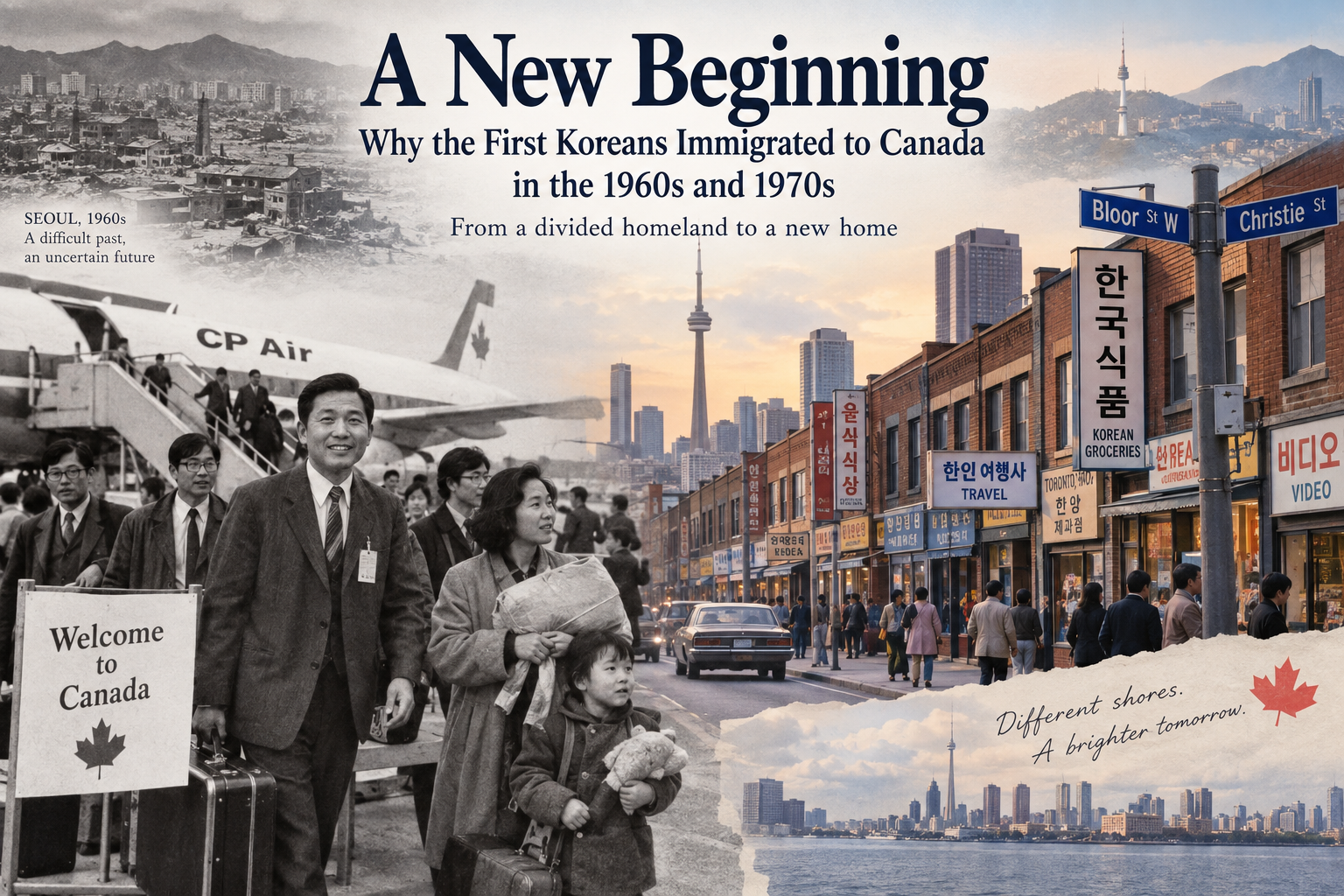
South Korea, Canada, and the Birth of Toronto’s First Koreatown in the 1960s and 1970s
When people walk through Toronto’s Koreatown around Bloor Street and Christie Street today, it is easy to see the neighbourhood simply as an established ethnic district: Korean restaurants, supermarkets, churches, travel agencies and businesses that have existed in one form or another for decades.
But the community did not appear randomly.
The Koreans who began arriving in significant numbers during the late 1960s and especially the 1970s were leaving a South Korea profoundly different from the wealthy, technologically advanced country familiar today. At the same time, Canada was undergoing its own transformation, dismantling immigration policies that had previously made large-scale Asian immigration extremely difficult.
The meeting of those two historical changes created modern Korean Canada.


South Korea in the 1960s Was Still a Poor Country
It is essentially correct to say that South Korea was still a developing country when the earliest large Korean migration to Canada began.
The Korean War had ended only in 1953. Much of the peninsula’s industrial infrastructure had been destroyed, millions of people had been displaced, and South Korea remained heavily dependent upon American and international assistance. A World Bank historical study notes that foreign aid accounted for 58.4 percent of the South Korean government’s budget in 1956. (World Bank)
The transformation that would eventually produce Samsung, Hyundai, LG and the modern Seoul skyline had barely started.
There is one technical qualification to the phrase “Third World.” During the Cold War, Third World originally referred primarily to countries outside the American-led First World and Soviet-led Second World rather than simply meaning “poor.” South Korea was firmly allied with the United States, so it was technically part of the Western bloc.
Economically, however, describing 1950s and early-1960s South Korea as a poor developing country is entirely reasonable.
And remarkably, North Korea initially had the stronger economy.
Yes, North Korea Was Once Richer Than South Korea
This is one of the strangest facts to consider from the perspective of modern Korea.
North Korea inherited a disproportionately large share of the peninsula’s heavy industrial infrastructure following Korea’s division. It also received significant assistance from the Soviet Union and other communist countries.
A World Bank study estimates that in the early 1960s, North Korean per-capita income may have been roughly twice that of South Korea. President Park Chung-hee himself reportedly regarded North Korea’s economic advantage as an existential challenge. (World Bank)
The exact year South Korea overtook North Korea is difficult to establish because North Korean economic statistics were unreliable even then. Some historical South Korean estimates put the crossover around the end of the 1960s, while other reconstructions place it somewhat later. A South Korean official recalled reporting to Park in 1969 that South Korean per-capita income had finally moved slightly ahead. (Wilson Center)
The important point is not the exact year.
When someone left South Korea for Canada in 1967, 1970 or 1973, they were not necessarily leaving an obviously successful country for another successful country. They were leaving a nation whose economic future was still uncertain.
South Korea’s extraordinary rise was underway, but nobody living through its early stages could know how successful it would eventually become.
Political Life Was Also Unstable
Economic insecurity was accompanied by political instability.
President Syngman Rhee was forced from office following the April Revolution of 1960. Only a year later, Park Chung-hee seized power in a military coup in 1961.
Park subsequently launched the economic-development programs that would help transform South Korea, but modernization came alongside increasingly authoritarian government. Political opposition was tightly controlled, and in 1972 Park introduced the Yushin Constitution, dramatically strengthening presidential power.
For the average Korean considering emigration, this did not necessarily mean that Canada was an escape from political persecution. Most Korean immigrants to Canada were not political refugees.
The attraction was broader: Canada appeared stable, wealthy, peaceful and predictable at a time when South Korea had experienced Japanese colonial rule, liberation, national division, war, revolution and military government within roughly a generation.
For parents thinking about their children, that difference mattered enormously.
South Korea Was Actually Encouraging Emigration
There is another fascinating piece of the story that is often overlooked.
In 1962, Park’s government enacted South Korea’s Emigration Act. The original legislation explicitly described overseas emigration as a means of supporting population policy and stabilizing the national economy. (eLaw)
Korea had a rapidly growing population, unemployment problems and an acute shortage of foreign currency.
Sending Koreans overseas could relieve some domestic pressure while eventually producing remittances and international connections.
This broader policy also explains famous episodes such as Korean miners and nurses going to West Germany. Some of those migrants later moved again rather than returning permanently to Korea. Research on former Korean miners who eventually settled in Toronto found that economic uncertainty in Korea, difficulty remaining in Germany and Canada’s receptive immigration policy all influenced their decision to move to Canada. (KCI)
Canada therefore became part of a much larger Korean movement outward during the country’s development era.
But Why Canada?
Until the 1960s, Canada was actually very difficult for Koreans to enter permanently.
There had been Koreans in Canada much earlier, particularly students and Christians connected to Canadian missionaries who had worked in Korea. Tae-yon Whang, a mission-sponsored medical intern who arrived in Toronto in 1948, is generally regarded as Canada’s first permanent Korean immigrant. (Students Commission Archives)
Yet the community remained tiny.
Around 1965, there were only about seventy Korean immigrants in all of Canada, with most concentrated in Toronto. (Épeinx )
Then Canadian immigration policy changed.
During the 1960s Canada progressively dismantled immigration rules that had heavily favoured Europeans. The decisive development came in 1967, when Canada introduced its universal points-based immigration system.
Rather than primarily asking where an applicant came from, Canada increasingly assessed such factors as education, occupational qualifications and employment potential. (Ministère de la Justice)
Suddenly, educated Koreans could qualify.
And South Korea happened to have exactly the kind of population Canada’s new immigration system favoured: ambitious young people who often possessed university education, professional training or technical skills.
The timing was almost perfect.
South Korea wanted greater overseas migration at almost exactly the moment Canada began allowing skilled Asian migrants to enter.
The Early Korean Immigrants Were Often Highly Educated
This helps explain something unusual about the earliest Korean community.
They were not necessarily Korea’s poorest people.
Many belonged to an educated urban middle class.
Historical accounts of Toronto’s Korean community describe a population that was disproportionately young and highly educated, often with post-secondary qualifications. (Épeinx )
Doctors, academics, engineers, pastors, businessmen and other professionals were represented among the pioneers.
They were essentially making a long-term bet.
Canada offered higher wages, political stability, English-language education for their children and the possibility of building wealth in a country whose standard of living was dramatically higher than Korea’s at the time.
But there was a painful catch.
A Korean Professional Could Become a Canadian Shopkeeper
Canadian employers frequently did not recognize foreign credentials or Korean professional experience.
An educated immigrant who had held a respectable white-collar position in Seoul might arrive in Toronto and discover that he could not obtain a comparable Canadian job.
Language made the problem worse.
Many immigrants therefore initially studied English, worked in factories or accepted lower-status jobs before accumulating enough capital to become self-employed. Historical accounts describe this occupational transition among early Toronto Koreans. (Épeinx )
That helps explain why convenience stores, groceries, restaurants, dry cleaners and other small family businesses became so strongly associated with first-generation Korean Canadians.
It was not necessarily because these people had been shopkeepers in Korea.
Entrepreneurship offered a way around Canada’s credential barriers.
Owning a small store meant that a Korean immigrant did not need a Canadian company to recognize his Korean degree.
In that sense, the cultural world later portrayed in Kim’s Convenience came out of a very real historical experience.
Why Bloor and Christie?
Once several Korean families established themselves in Toronto, immigration began producing its own momentum.
New arrivals naturally wanted to live somewhere where another Korean could tell them where to find housing, employment, Korean groceries, English classes or a church.
Research on early Korean settlement describes the Bloor area as attractive partly because of its inexpensive rooming houses and access to information through the emerging Korean community. (KCI)
The commercial community then followed the residents.
One study dates Toronto’s first Korean grocery store, Sammi Food, to February 1969. Additional Korean businesses appeared along Bloor Street between Christie and Bathurst during the early 1970s. (KRM)
Restaurants appeared.
Then grocery stores.
Then bakeries, travel agencies, gift shops and professional services.
A neighbourhood that happened to contain Koreans gradually became a place where being Korean itself generated economic activity.
By 1966, Toronto reportedly contained only around 100 Koreans. By the end of 1969, contemporary community estimates put the number above 2,000, and by 1975 community leaders estimated roughly 10,000 Koreans in greater Toronto. (Épeinx )
That is an extraordinary transformation in less than a decade.
The Church Came Before Koreatown
There was another institution even more important than the restaurant or grocery store: the Korean church.
Christianity had already produced connections between Korea and Canada through generations of Canadian missionaries.
When Toronto’s Korean population began growing, one of its first collective institutions was therefore religious rather than commercial.
The first service of what became the Toronto Korean United Church was held on April 23, 1967, with sixty organizing members. (Students Commission Archives)
But churches did far more than conduct Sunday services.
For someone arriving from Seoul with limited English and few Canadian connections, a Korean church could effectively function as a settlement agency, employment network, social club, information centre and extended family.
Someone at church might know who was hiring.
Someone might know about an apartment.
Someone might know how Canadian banking worked.
Someone might introduce a newly arrived family to another Korean family.
This produced chain migration: one successful immigrant helped a relative or friend come, who then helped another.
Canada’s Korean population began reproducing itself through social networks.
Vancouver Had a Korean Community Too
Toronto was the dominant early centre, but Vancouver was not absent.
Vancouver’s Korean population was also extremely small during the early 1960s. British Columbia historical records describe approximately 50 Koreans in Vancouver during the mid-1960s, growing to about 1,670 by 1975. (Wikipedia)
A Korean United Church appeared there during the 1960s, followed by Korean grocery stores and restaurants in the early 1970s.
Vancouver’s much larger Korean presence—the North Road area of Burnaby and Coquitlam, for example—developed substantially later.
So the modern geography can be slightly misleading. Vancouver today feels like an obvious Korean destination because of its Pacific location and strong connections with Asia, but Toronto was the primary institutional centre of early Korean Canada.
What About Montreal?
The federal government records Toronto, Vancouver, Montreal, Edmonton and Calgary among destinations for Korean immigrants, so Montreal was certainly part of the story. (Canada)
But the early Montreal Korean community remained much smaller. Accounts of Korean Montreal describe some arrivals in the 1950s and 1960s but suggest that the community’s much more noticeable growth occurred later, especially from the late 1980s onward. (The Main)
Language likely mattered as well.
A Korean immigrant already faced the difficult task of mastering English. Toronto and Vancouver allowed that person to operate almost entirely in English once outside the Korean community.
Quebec increasingly required navigating French as well.
Following the political and linguistic changes of the 1970s, particularly Quebec’s stronger promotion of French, Toronto became an even more straightforward choice for many immigrants seeking an English-speaking North American future.
Interestingly, Quebec later actively recruited Korean business and investment immigrants during the late 1980s, temporarily increasing Montreal’s share of Korean immigration. Statistics Canada research specifically notes the effect of Quebec’s recruitment policies on Korean settlement during that period. (Publications.gc.ca)
They Could Not Have Known What Korea Would Become
Perhaps the most interesting way to understand those early immigrants is to avoid looking backward through the lens of modern South Korea.
Imagine Seoul around 1965 without knowing what happens next.
There is no Samsung Galaxy.
No Hyundai global automotive empire.
No Gangnam skyline.
No K-pop.
No globally influential Korean entertainment industry.
No guarantee that South Korea will become wealthier than many European countries.
You have instead grown up amid colonialism, war, poverty and political upheaval. North Korea may have recently been economically stronger than your own country. A military government runs South Korea. Canada, meanwhile, appears enormous, peaceful, wealthy and politically stable.
Then Canada suddenly announces that an educated Korean professional can qualify for immigration based largely on skills rather than race or nationality.
For many families, the decision becomes understandable.
It was not necessarily “Korea is terrible, so we must escape.”
It was closer to:
“Korea’s future is uncertain. Canada appears to offer our children possibilities that we cannot yet be sure Korea will provide.”
And those immigrants arrived at exactly the moment South Korea itself began one of the most remarkable economic transformations in modern history.
Some of the people opening grocery stores around Bloor and Christie during the 1970s had therefore left Korea just before the country they departed became dramatically wealthier.
Their children grew up Canadian while their parents’ homeland transformed almost beyond recognition.
That unusual timing is one of the reasons the first generation of Korean Canadians has such a distinctive history.
Toronto’s original Koreatown was not simply created because Koreans liked living together. It was the physical result of two countries undergoing historic transformations at the same moment: South Korea opening outward as it struggled to develop, and Canada finally opening its doors to skilled immigrants from Asia.
And where those two transformations met, around a relatively inexpensive stretch of Bloor Street in Toronto, a Korean-Canadian community took root.