How about meeting here on Wednesday, September 30th, sometime around 2–3 PM instead of tomorrow? I have a work meeting tomorrow, so I won’t be available during the day.
I looked around and I think this place would be a good spot for us to meet and film.
It doesn’t necessarily have to be Wednesday either. Any weekday works for me as long as we can meet around 2–3 PM!
How about meeting here on Wednesday, September 30th, sometime around 2–3 PM instead of tomorrow? I have a work meeting tomorrow, so I won’t be available during the day.
I looked around and I think this place would be a good spot for us to meet and film.
It doesn’t necessarily have to be Wednesday either. Any weekday works for me as long as we can meet around 2–3 PM!
Hiking is one of South Korea’s most ordinary hobbies. Mountains are everywhere, trails are easily accessible from major cities, and hiking has traditionally attracted everyone from retirees and office workers to organized social clubs.
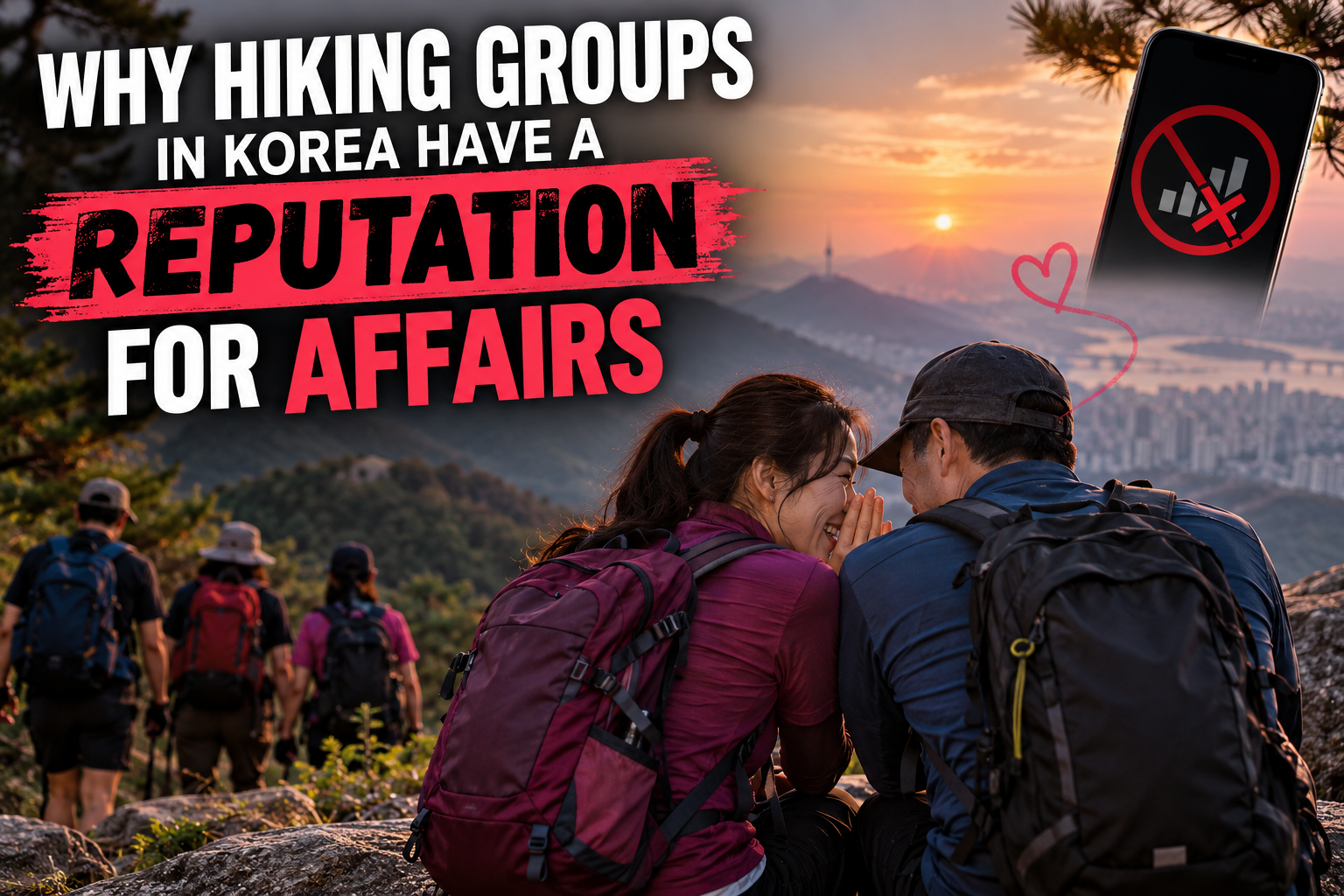
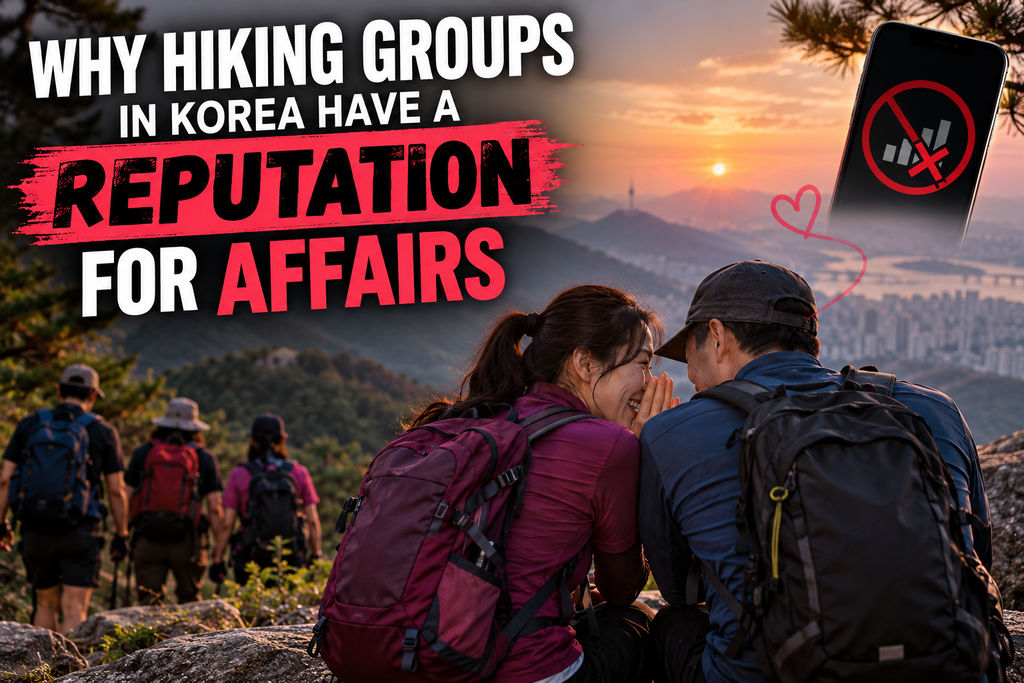
But Korean hiking clubs—especially the traditional 산악회 (sanakhoe)—have also developed another, less wholesome reputation: as places where married people sometimes meet romantic or sexual partners outside their marriage.
That reputation is not entirely invented. Korean media have discussed the association between hiking clubs and affairs for years. At the same time, it would obviously be wrong to assume that hiking clubs exist for this purpose, or that most hikers are cheating on their spouses.
The more interesting question is why hiking, specifically, became associated with affairs in the first place.
The Perfect Excuse to Disappear for a Day
One important feature of hiking is simply its duration.
A person can leave home early in the morning and return in the evening without the schedule appearing unusual.
A typical explanation might be:
“I’m going hiking with the club today.”
That statement can account for six, eight or even twelve hours away from home.
Unlike meeting someone for coffee or dinner, there is nothing inherently suspicious about being gone for most of the day when climbing a mountain.
Traditional Korean hiking clubs also frequently involve transportation to mountains outside one’s home city. Members might meet early in the morning, take a chartered bus to a mountain, hike for several hours, eat afterward and return home late.
That creates a naturally large window of unstructured time.
The Mountain Also Provides Plausible Unavailability
Another reason hiking acquired this reputation is communication.
Historically, mountainous terrain made mobile-phone communication much less reliable than it was inside Korean cities. A spouse who did not immediately answer a telephone call could simply explain:
“There was no signal on the mountain.”
Even today there can be weaker reception in remote mountainous areas, valleys and isolated trails.
However, this explanation should not be exaggerated in modern South Korea. Korean telecom companies have invested extensively in mountain and hiking-trail coverage. SK Telecom, for example, specifically lists hiking trails and remote mountain regions among the areas where it has installed LTE and 5G infrastructure.
In June 2026, SK Telecom even documented network testing on Hallasan—the highest mountain in South Korea—and reported functioning calls and social-media connections during the climb.
So today, “there is no reception while hiking” is far less universally believable than it might once have been.
The broader advantage remains, however: hiking provides a socially acceptable reason to be less responsive.
Someone climbing a steep trail can legitimately say that they were concentrating on the hike, conserving their battery, keeping their phone inside their backpack or simply enjoying time away from their device.
Hiking Clubs Create Repeated Contact
There is another ingredient that may actually be more important than cellphone reception: repetition.
Affairs rarely begin because two strangers suddenly decide to cheat.
They often develop through repeated contact.
A hiking club can bring the same men and women together every weekend.
People spend hours talking while walking.
They travel together on buses.
They eat together afterward.
They may drink together after completing the hike.
Relationships gradually become familiar.
Someone who originally joined because they enjoyed mountains can therefore develop friendships—and occasionally romantic relationships—with other members.
Hiking also creates long stretches of conversation without the distractions found in normal urban social environments.
Walking next to someone for three hours can produce considerably more personal conversation than sitting across from them at a crowded restaurant for thirty minutes.
Korea Has Actually Talked About the Affair Connection
The stereotype became strong enough that Korean media have covered it directly.
In 2014, The Korea Times reported on middle-aged hikers allegedly using signals and nicknames to indicate that they were interested in sexual encounters while hiking. The article described reports of hikers using informal codes to communicate romantic availability.
Korea’s specialist hiking publication Monthly Mountain had also previously acknowledged that hiking clubs sometimes experienced internal disputes involving money, alcohol and relationships between men and women.
That does not establish how common affairs actually are. There appears to be no reliable national statistic saying something like “X percent of Korean hiking-club members commit adultery.”
What it demonstrates is that the stereotype has existed strongly enough in Korean society to become a recognizable cultural phenomenon.
And the stereotype can sometimes become unfair.
A later Monthly Mountain article discussing commercial hiking groups specifically noted that people sometimes view hiking clubs suspiciously, while observing that the particular group followed for the article displayed neither affair-related behavior nor disruptive drinking.
In other words, the reputation exists—but it should not be confused with describing every hiking club.
Why It Became Especially Associated With Middle Age
The traditional stereotype usually concerns people in their 40s, 50s and 60s rather than young single hikers.
That makes sense sociologically.
Many people in this age group have been married for decades. Their children may be older. They may have more independence than they did while raising a young family.
At the same time, joining an ordinary singles event would immediately raise questions.
Joining a hiking club does not.
Exercise is respectable.
Being outdoors is healthy.
Meeting other people through a hobby appears innocent.
The activity therefore provides something extremely useful to anyone looking for privacy:
plausible deniability.
The Bus Ride May Be as Important as the Mountain
Traditional Korean hiking groups frequently organize buses to mountains far outside Seoul or other large cities.
That creates another unusual social environment.
Members meet early in the morning, spend hours traveling together, hike together, eat together and then spend another several hours returning home.
A twelve-hour hiking trip therefore contains much more than hiking.
People sit beside one another on buses.
Groups split into smaller groups.
Members exchange food.
Alcohol sometimes appears after the hike.
People form friendships.
From a relationship-development perspective, this resembles a miniature day trip rather than simply an exercise club.
The mountain provides the reason for everyone to be there.
The social network surrounding the mountain creates the relationships.
Korea’s Hiking Culture Is Enormous
It is also important to remember the scale of Korean hiking culture.
A 2025 Korea Forest Service survey released in January 2026 found that 73 percent of Korean adults surveyed engaged in hiking or other forest-trail activities at least once per month. The same survey found that 36 percent of hikers reported hiking alone, demonstrating how normalized hiking has become as part of everyday Korean life.
That scale matters.
When millions of people participate in an activity, almost every kind of human relationship will appear inside it: friendships, business connections, romances, marriages—and occasionally affairs.
Hiking clubs are essentially small social societies built around exercise.
Modern Hiking Culture Is Changing
The stereotype of the middle-aged hiking club is also becoming somewhat dated.
Korean mountains are increasingly filled with younger hikers.
Social media, climbing culture, fitness communities and outdoor fashion have helped turn hiking into something popular among people in their 20s and 30s.
In 2026, for example, Korean media reported large numbers of younger hikers visiting mountains such as Gwanaksan as hiking trends spread across Instagram and other social-media platforms.
Modern hiking groups can therefore look considerably different from the traditional 산악회 image.
Some are exercise groups.
Some are Instagram groups.
Some are dating-adjacent social groups.
Some are serious mountaineering organizations.
And many are simply people who like climbing mountains.
The Real Ingredient Is Opportunity, Not the Mountain
There is nothing inherently adulterous about hiking.
What hiking clubs can provide, however, is a combination of circumstances that historically made discreet relationships easier:
long periods away from home, mixed-gender socializing, repeated weekly contact, trips outside one’s neighborhood, socially acceptable reasons for spending an entire day away, and historically less reliable communication while in mountainous areas.
Put those ingredients together and it becomes easier to understand why Korean hiking clubs acquired their particular reputation.
The absence of cellphone reception may have helped reinforce the image, especially in earlier decades.
But the deeper factor is probably social cover.
Few spouses would find it unusual for someone to say:
“I’m going hiking Saturday. I’ll be back tonight.”
And for anyone seeking a few hours outside their ordinary social world, that can provide considerably more freedom than saying:
“I’m going out to meet someone.”
That doesn’t make hiking clubs cheating clubs.
But it does explain why, among all of Korea’s seemingly innocent social hobbies, the humble 산악회 developed one of the country’s more mischievous reputations.