Dating in Korea can sometimes feel surprisingly organized to Westerners.
There is the first date. Then perhaps a second and third date. At some point somebody may explicitly ask the other person to become their boyfriend or girlfriend. From that moment, the couple starts counting the days.
Then come 100 days, 200 days, 300 days, one year, birthdays, Christmas, Valentine’s Day, White Day and even Pepero Day.
But how much of this is actually Korean culture, and how much is an exaggerated internet version of Korean dating?
Here is a realistic guide to what traditionally or commonly happens at each stage of a Korean relationship.
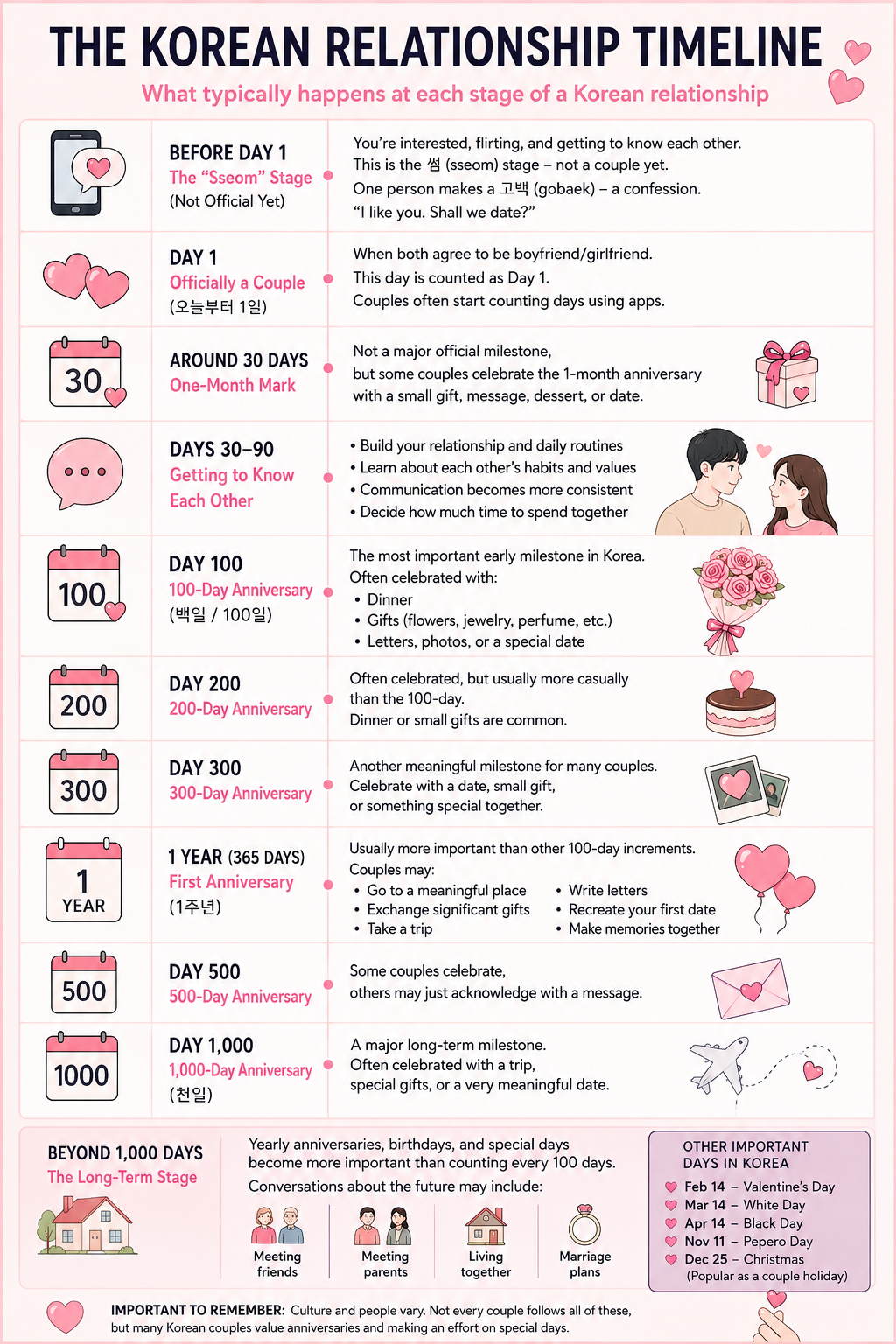
Before Day 1: You Are Not Necessarily a Couple Yet
One of the biggest differences between Korean and contemporary Western dating culture is the importance traditionally placed on making the relationship explicit.
Two people can go out several times, message each other constantly and clearly be romantically interested without automatically assuming that they are officially boyfriend and girlfriend.
This ambiguous period is often associated with 썸 (sseom) — essentially the stage where “something” romantic is developing.
Eventually one person may make a 고백 (gobaek), literally a confession.
That does not necessarily mean dramatically declaring undying love beneath the cherry blossoms like a K-drama character.
It can simply mean saying something equivalent to:
“I like you. Should we date?”
Or:
“우리 사귈래?” — “Do you want to be a couple?”
Once both people agree, the relationship has a clearly defined starting point.
That date becomes Day 1.
The Famous “Third Date Rule”
You will sometimes hear that Koreans are supposed to become boyfriend and girlfriend by the third date.
There is some truth behind the stereotype, but it should not be treated as a Korean law of romance.
Three dates can be enough for two people who met through a 소개팅 (sogaeting, a blind date or arranged introduction) or dating app to decide whether they want to pursue a relationship.
Because Korean dating has traditionally put more emphasis on explicitly establishing couple status, the “What are we?” conversation may happen somewhat earlier than it does in Western situationships.
But there is no universally recognized Korean rule saying a confession must happen on Date Three.
Some people become a couple after two or three meetings. Others spend weeks in the 썸 stage.
The important cultural difference is less about the number three and more about eventually defining the relationship clearly.
Day 1: “오늘부터 1일” — Today Is Our First Day
Once the couple becomes official, Korean anniversary mathematics begins.
The day the relationship starts is counted as Day 1, not Day 0.
So if a couple officially starts dating on April 1, their 100th day is July 9 — 99 calendar days later.
This way of counting relationships is so familiar in Korea that couple apps and D-Day counters can automatically track milestones.
Young couples may even display the number of days they have been together on profiles or relationship apps.
Day 1 therefore matters more in Korean dating culture than it often does in the West.
You need to remember the date.
Days 1–30: Becoming an Actual Couple
The first month is primarily about establishing the rhythm of the relationship.
Once official, couples may begin behaving publicly and socially as a couple rather quickly.
Common practices can include:
- frequent KakaoTalk messages
- good-morning or good-night messages
- regular dates
- holding hands and other moderate public affection
- taking couple photos
- changing profile pictures
- using affectionate nicknames
- buying small matching “couple items”
Matching items are known broadly as 커플템 (couple-tem).
They might be matching phone cases, shoes, keychains, hoodies or accessories. Couple rings can also appear surprisingly early by Western standards and do not automatically mean engagement.
Daily communication can also be more important to some Korean couples than Western daters expect. A reduction in messaging may therefore be interpreted as declining interest by a partner who is accustomed to frequent contact.
None of this is compulsory, however.
Day 30: The One-Month Mark
Thirty days is where some online guides exaggerate Korean dating culture.
There is no major nationwide Korean tradition requiring a special event at exactly 30 days.
Some younger couples celebrate one-month anniversaries, particularly during the honeymoon stage. A small gift, message, dessert or additional date would not be unusual.
But 30 days is nowhere near as culturally significant as 100 days.
Think of it as:
Nice to acknowledge, but not mandatory.
Days 30–90: Building the Relationship
By this point, the novelty of becoming an official couple begins turning into an ordinary relationship.
Couples usually learn things that cannot really be discovered during three carefully planned dates:
How often does the other person want to communicate?
Who normally pays?
How much time should they spend together?
How jealous or independent is each person?
How do they behave around friends?
What constitutes appropriate interaction with opposite-sex friends?
Korean dating historically contained stronger gender expectations than contemporary Canadian or American dating, including an expectation that the man often pays more.
That is changing considerably.
A common modern pattern is that one person pays for dinner while the other pays for coffee, dessert or the next activity rather than splitting every individual bill exactly in half.
Ultimately, younger couples increasingly create their own arrangement.
Day 90: Surprisingly, Nothing Special
If you were expecting Day 90 to be another major Korean relationship checkpoint, this is one of the myths worth clearing up.
There is no widely recognized 90-day Korean relationship tradition.
At 90 days, however, something important is approaching:
100일 — the 100th day.
A couple that cares about anniversary culture may therefore start deciding what they want to do for their first major milestone.
Day 100: The Big One
This is the milestone that really is culturally important.
The 100-day anniversary — 백일 or 100일 — is traditionally the first major celebration of a Korean relationship.
The number 100 already carries symbolic importance in Korean culture. A baby’s 100th day, for example, has traditionally been celebrated.
Modern couple culture adapted that symbolism to romantic relationships.
A 100-day celebration might involve:
- a particularly nice dinner
- flowers
- a handwritten letter
- a cake
- jewelry
- perfume or another personal gift
- matching accessories
- couple rings
- photographs together
- a special day trip
- occasionally a hotel stay or weekend getaway
Not every couple does all of these things.
The safest interpretation is that 100 days should normally be acknowledged if your Korean partner considers anniversaries important.
For teenagers and people in their twenties, 100-day culture tends to be more pronounced. Older couples may treat it much more casually.
Day 200: Still an Anniversary, Usually Smaller
Two hundred days can also be celebrated.
However, it generally does not carry quite the same “first major milestone” status as Day 100.
A couple might simply have dinner, exchange small gifts or acknowledge the date.
By this point, constantly buying expensive presents every hundred days would obviously become financially ridiculous, so many established couples gradually simplify the ritual.
The important thing becomes remembering rather than continually escalating the price of the gift.
Day 300: Another Couple Milestone
Three hundred days is another recognizable relationship anniversary.
Again, there is no required activity.
Dinner, a small present, flowers, a letter or a day out together would all fit naturally.
Some couples celebrate every 100 days enthusiastically.
Others celebrate 100 days and then largely jump to their yearly anniversary.
Both are normal.
Day 365: The First-Year Anniversary
The first anniversary — 1주년 — is usually more important than another ordinary 100-day increment.
This resembles Western anniversary culture much more closely.
Couples may:
- go somewhere meaningful from the beginning of their relationship
- book a nicer restaurant
- exchange significant gifts
- write letters
- make a photo album
- take a weekend trip
- recreate their first date
- buy couple jewelry
For a serious relationship, the first year can also naturally produce conversations about the future.
But there is no Korean rule saying that meeting the parents, becoming engaged or moving in together must occur after one year.
Those transitions depend much more heavily on age, finances, family expectations and whether the couple is dating with marriage in mind.
500 Days
Five hundred days is another number sometimes marked by Korean couples.
Like 200 and 300 days, its importance varies enormously from couple to couple.
Younger anniversary-conscious couples may plan something special.
Others might simply send:
“우리 500일 축하해 ❤️”
“Happy 500 days to us.”
And continue with their day.
1,000 Days
1,000 days — 천일 — is one of the more recognizable long-term day-count milestones.
One thousand days is about two years and nine months.
Reaching four digits makes it psychologically satisfying, and couples who enjoy counting days may treat it as a major celebration.
A trip, expensive dinner, jewelry or particularly meaningful gift would not be unusual.
By this stage, however, a serious adult Korean couple may be thinking less about novelty anniversaries and more about practical questions concerning marriage and long-term compatibility.
Two Years, Three Years and Beyond
As relationships mature, yearly anniversaries generally become more practical than counting every 100 days.
This is especially true among older couples.
A teenager might get excited about 200일, 300일 and 500일.
A couple in their thirties who has been together for four years is considerably more likely to focus on:
- birthdays
- yearly anniversaries
- Christmas
- vacations
- marriage plans
- family events
Korean anniversary culture is therefore partly generational.
The younger the couple, the more visible the day-counting culture tends to be.
When Do You Meet the Friends?
There is no Korean “Day 50: meet the friends” rule.
Friends may learn about a relationship almost immediately, particularly because friends often discuss dating lives extensively.
A partner might eventually join the other person’s friend group for dinner or drinks.
The timing depends on the people involved rather than an anniversary number.
When Do You Meet the Parents?
Meeting friends and meeting parents are very different things.
Traditionally, introducing a boyfriend or girlfriend to one’s parents can carry more significance in Korea than a casual introduction might in some Western families.
For people dating seriously with marriage in mind, meeting the family may signal that the relationship has entered a more serious phase.
That does not mean every Korean family interprets it this way.
Some young adults casually introduce partners. Others will avoid parental introductions until marriage is genuinely being discussed.
There is therefore no 100-day or one-year rule for meeting the parents.
When Do Korean Couples Have Sex?
There is no factual Korean timetable saying sex is supposed to happen on the first, third, tenth or hundredth date.
Attitudes toward premarital sex have liberalized greatly across younger generations, while considerable individual variation remains.
Some couples become physically intimate before officially defining the relationship.
Some wait until they are committed.
Some wait considerably longer.
Korean culture may be highly visible about cute public couple behavior while still remaining comparatively private regarding actual sexual relationships.
Holding hands in Gangnam tells you very little about what happens when the couple goes home.
When Do Couples Move In Together?
Historically, premarital cohabitation carried considerable stigma in South Korea.
That is changing quickly.
A 2026 survey of 1,050 unmarried Koreans aged 19–49 found 79.4 percent considered cohabitation as part of preparing for marriage acceptable.
That is a major cultural shift.
Nevertheless, living together is still much more consequential than exchanging couple rings or celebrating 100 days.
There is no culturally prescribed date by which a Korean couple should move in together.
And When Does Marriage Enter the Picture?
For younger casual couples, it might not.
For Koreans dating seriously in their late twenties, thirties or beyond, questions about marriage can appear substantially earlier.
Marriage in Korea involves more than the relationship itself. Housing costs, careers, parental expectations, wedding expenses and plans regarding children can all affect the decision.
This is why two Korean relationships can appear completely different.
A 21-year-old university couple may celebrate 100 days with matching sneakers.
A 34-year-old couple introduced specifically because both want marriage may be discussing housing and families within months.
Both are Korean dating.
The Other Dates You Need to Remember
Relationship anniversaries are only part of Korea’s romantic calendar.
February 14 — Valentine’s Day
Traditionally, women give chocolate or gifts to men.
Modern couples are considerably less rigid about the gender division, but Valentine’s Day remains important.
March 14 — White Day
Traditionally, men reciprocate one month later by giving gifts to women.
April 14 — Black Day
This is more associated with single people, famously involving jjajangmyeon, the dark black-bean noodles.
November 11 — Pepero Day
Because 11/11 resembles four Pepero sticks, couples and friends exchange the chocolate-covered snacks.
Pepero Day has become one of Korea’s most recognizable commercial relationship-related occasions.
Christmas
This can surprise Westerners.
Christmas in South Korea has a strong romantic-couple component.
Rather than being almost exclusively a family holiday, Christmas Day is a popular date night. Restaurants and romantic locations can become busy with couples.
A foreigner dating a Korean therefore should not automatically assume that Christmas is simply a day each person spends separately with family.
What About the “Romantic 14th of Every Month”?
You may find English-language websites claiming Korea has an elaborate romantic holiday every 14th of the month:
Rose Day, Kiss Day, Silver Day, Photo Day, Wine Day, Movie Day, Hug Day and so forth.
These lists do exist.
But foreigners should be careful about interpreting them.
Many of these themed days have been amplified by marketing and internet culture and are nowhere near as universally observed as Valentine’s Day, White Day or Pepero Day.
A Korean partner is unlikely to end a healthy relationship because you forgot “Movie Day.”
The online version of Korean couple culture sometimes makes Korean dating sound like completing monthly quests in a video game.
Real relationships are considerably more normal.
So What Is the Real Korean Relationship Timeline?
A realistic version looks something like this:
Dates 1–3+
Determine whether there is mutual romantic interest.
The confession — 고백
One person explicitly proposes becoming a couple.
Day 1
The official relationship begins and the anniversary counter starts.
Around 30 days
Some younger couples acknowledge one month, but it is not a major universal milestone.
Days 30–90
The couple develops its normal communication, dating and intimacy patterns.
Day 90
No major traditional significance. The 100-day anniversary is approaching.
Day 100
The first genuinely major Korean couple milestone. Usually worth acknowledging.
Day 200
Often celebrated, typically more casually.
Day 300
Another possible anniversary.
One year
Major relationship anniversary.
Day 500
Sometimes celebrated.
Two years and beyond
Yearly anniversaries increasingly replace frequent 100-day celebrations.
Day 1,000
A recognizable long-term day-count milestone.
Long-term serious relationship
Family introductions, cohabitation, finances and marriage discussions occur according to the couple’s circumstances rather than predetermined day numbers.
The Most Important Korean Dating Rule Is Not a Number
Perhaps the most useful lesson is that Korean dating culture places unusual emphasis on 챙기다 — remembering and taking care of things that matter.
The problem usually is not that you failed to spend enough money.
The problem is realizing at 9:45 p.m. that today was your 100th day and saying:
“Oh. Was that today?”
That communicates something very different from remembering the occasion and suggesting a simple dinner.
And modern Korean couples are far from identical.
A Korean girlfriend may love couple rings, matching hoodies and elaborate anniversary dinners.
Another Korean woman may find the entire thing childish and tell you that birthdays and yearly anniversaries are enough.
So the smartest approach for a foreigner dating in Korea is neither to ignore Korean couple culture nor blindly follow an internet checklist.
Understand the milestones.
Remember the important dates.
Then find out which ones actually matter to the person you’re dating.