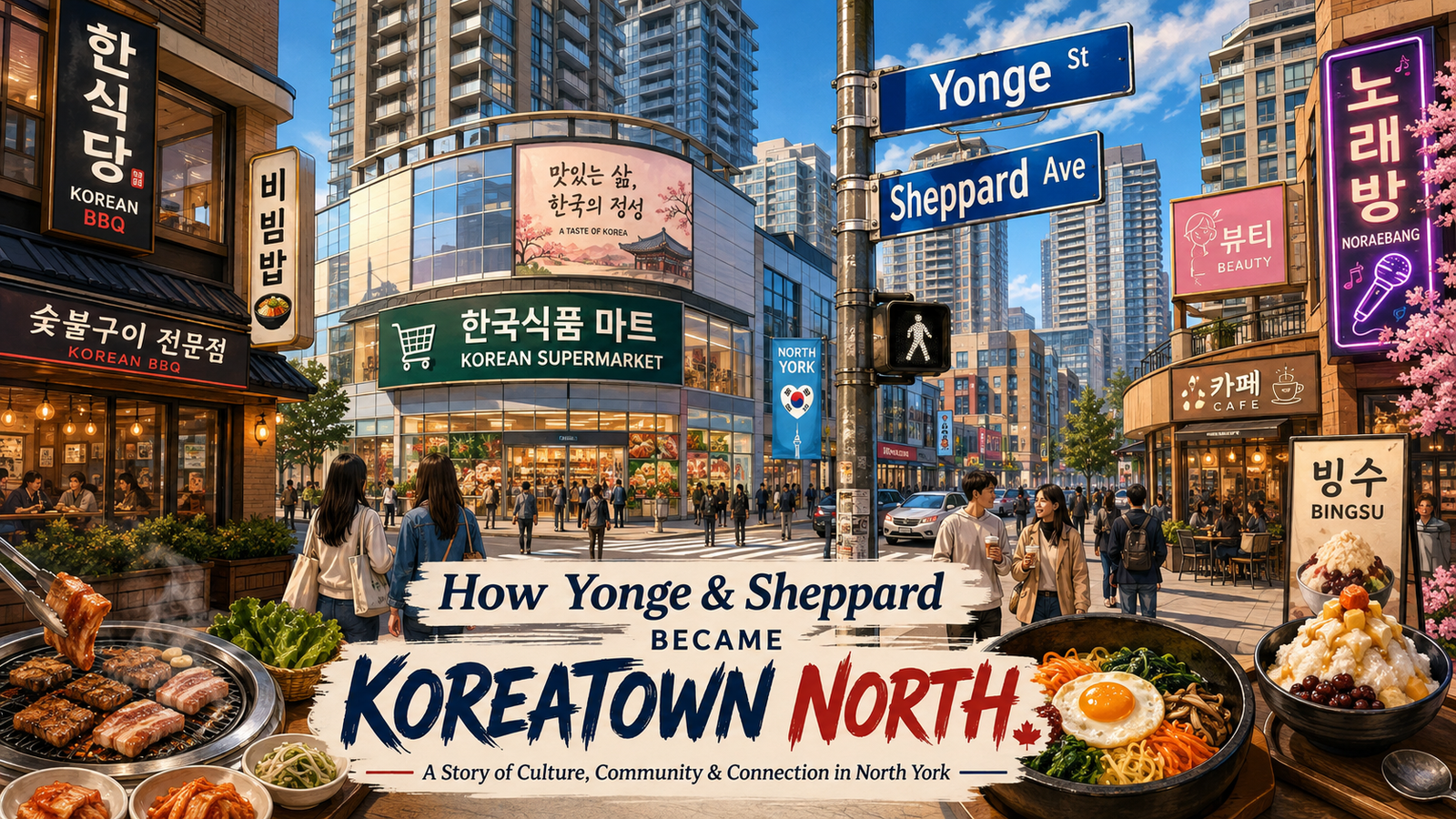
The story of Koreatown North — and how a stretch of North York became one of the most Korean places in Canada


Ask someone unfamiliar with Toronto where the city’s Koreatown is, and they will probably point to Bloor Street between Christie and Bathurst.
Historically, they would be right.
But spend enough time in Toronto’s Korean community and a different answer begins to emerge: go north.
Today, the stretch of Yonge Street beginning around Sheppard Avenue and continuing through North York Centre and Finch has developed into what is commonly called Koreatown North, Uptown Koreatown, or simply the Yonge and Finch Korean area. Korean community organizations describe the main North York Koreatown as lying between Sheppard and Finch stations, with Korean businesses continuing farther north toward Steeles. (KCWA)
And unlike some historic ethnic districts where the original community has largely moved elsewhere, North York’s Korean character is not just decorative. People actually live, shop, eat, socialize and conduct everyday business in Korean here.
So how did a suburban stretch of Yonge Street become Toronto’s second Koreatown?
Toronto’s First Koreatown Was Downtown
The story begins several kilometres south.
Korean immigration to Toronto was tiny in the middle of the twentieth century. That changed dramatically after Canada reformed its immigration system in 1967, removing many of the old nationality-based restrictions.
During the late 1960s and 1970s, growing numbers of South Koreans arrived in Canada. Toronto became one of their most important destinations.
Many settled around Bloor and Bathurst.
Restaurants appeared. Korean grocery stores opened. Travel agencies, churches, bakeries, bookstores and other businesses followed. By the 1970s, Bloor Street had developed a recognizable Korean commercial district. (Wikipedia)
That became the Koreatown older Torontonians still associate with the name.
But immigrant neighbourhoods rarely remain frozen in time.
As Korean families became more established economically, many began moving outward from Toronto’s older downtown neighbourhoods.
And one of the places they increasingly chose was North York.
The Korean Migration North
The Korean presence in Willowdale began becoming noticeable during the 1990s and accelerated around the end of that decade. By roughly 2000, Korean community organizations were describing a significant relocation of Korean Canadians into North York. (KCWA)
This didn’t mean Bloor Koreatown disappeared.
Instead, Toronto effectively developed two different Koreatowns.
Bloor became the historic Koreatown: older, compact and strongly associated with the first generations of Korean immigration.
North York became something different: a newer residential and commercial centre closely connected to where Korean Canadians were increasingly living.
That distinction matters.
An ethnic neighbourhood becomes much more durable when it isn’t simply a restaurant district for visitors. In Willowdale, Korean businesses were surrounded by Korean residents who needed groceries, accountants, doctors, hairdressers, churches, restaurants, cafés and entertainment.
The ecosystem could support itself.
Why Yonge Street?
The location wasn’t accidental.
Long before the Korean population became prominent, North York had spent decades transforming the Sheppard-to-Finch section of Yonge into its own downtown.
The Yonge subway reached Finch in the 1970s. North York Centre station opened in 1987. Major residential and commercial developments followed, including Empress Walk in the late 1990s, and the Sheppard subway opened in 2002. The former City of North York deliberately encouraged high-density residential and commercial growth along this corridor. (Wikipedia)
The result was almost ideal for a new immigrant commercial district.
People could live in a condo, take the elevator downstairs, walk to Yonge Street, eat dinner, buy groceries, meet friends, take the subway downtown and return without owning a car.
At the same time, Yonge Street provided a natural north-south connection to the growing Korean populations of Newtonbrook, Thornhill and the northern GTA.
So rather than appearing as an isolated Korean pocket, the Sheppard-Finch corridor became the southern portion of a much longer Korean suburban axis stretching north.
Eventually the Numbers Became Impossible to Ignore
By the 2016 Census, 10,670 people in the Willowdale federal riding reported Korean as their mother tongue. Statistics Canada also counted more than 12,000 residents there within its Korean visible-minority category. (Statistics Canada)
Those are extraordinary numbers for one Toronto neighbourhood.
Older residents have also described watching Yonge Street change in real time. An oral-history project about North York records memories of a period when there were relatively few Asian restaurants along this stretch, followed by the proliferation of Korean and other Asian establishments between Sheppard and Finch. (ArcGIS StoryMaps)
The Hangul signs weren’t creating the Korean population.
They were following it.
Sheppard Is Really the Southern Gateway
Calling the neighbourhood “Yonge and Sheppard Koreatown” can be slightly misleading.
Sheppard is better understood as the southern gateway.
From Yonge and Sheppard, the Korean presence becomes increasingly visible as you move north past North York Centre toward Finch. Around Finch, Korean signage, restaurants, cafés and karaoke rooms can become especially concentrated.
And it doesn’t abruptly end at Finch.
Korean businesses continue toward Steeles and then into Thornhill and other parts of York Region. (KCWA)
In other words, Koreatown North isn’t a few blocks with ceremonial gates.
It’s a corridor.
The Korean Supermarkets
One of the clearest signs that this is a living Korean neighbourhood rather than simply a restaurant destination is its grocery infrastructure.
Near Sheppard there is H Mart Sheppard, while nearby Galleria Supermarket Sheppard adds another major Korean grocery option. Tucked just east of Yonge is PAT Spring Garden Market.
These stores carry the things required for ordinary Korean home cooking: kimchi, gochujang, doenjang, seaweed, rice, noodles, tofu, frozen dumplings, Korean vegetables, seafood, sliced meats, snacks, drinks and prepared banchan.
There is even specialized shopping such as The Owl’s Meat Shop 부엉이 정육점, which focuses heavily on cuts and preparations suited to Korean cooking and barbecue.
That grocery network is important culturally. You can live in North York and cook much the same food you would cook in Seoul without treating Korean ingredients as exotic specialty purchases.
Korean Food Everywhere
Then there are the restaurants.
North York Koreatown offers considerably more than Korean barbecue.
Within the corridor you can find samgyeopsal, galbi and bulgogi, but also gamjatang, sundubu-jjigae, kimchi-jjigae, naengmyeon, jokbal, bossam, tteokbokki, Korean fried chicken, gimbap, bibimbap, mandu and countless varieties of soup and stew.
There are also restaurants devoted to foods that once would have been considered too specialized for the Canadian mainstream. Bonjuk, for example, revolves around Korean juk — rice porridge and comfort food.
That’s one sign a diaspora food scene has matured.
A neighbourhood no longer needs every restaurant to sell the same handful of internationally famous dishes. Businesses can specialize because enough customers already understand the cuisine.
The Korean Café Culture
Korea’s café culture made the trip to North York as well.
Cafe Kray serves the kind of bingsu, drinks and desserts associated with contemporary Korean cafés.
Farther north, 달제과 LUNA BAKERY combines coffee with Korean rice cakes and traditional-style sweets.
These places are culturally important in a different way from the older family restaurant.
Modern Korean social life frequently revolves around cafés. Friends may eat dinner and then relocate somewhere else for coffee, cake or bingsu rather than immediately going home.
That same pattern works remarkably well in North York because so many businesses sit within walking distance of one another.
And Of Course, Noraebang
A Korean district would feel incomplete without 노래방 — noraebang.
Private-room karaoke is deeply embedded in Korean nightlife, and the Finch portion of the corridor has developed its own miniature noraebang ecosystem.
There is Shout Karaoke near Finch, while Echo Coin Karaoke brings the Korean coin-karaoke concept into the neighbourhood.
Instead of standing on a public stage in front of strangers, groups rent private rooms and sing together — a very different experience from the stereotypical North American karaoke bar.
The late hours matter too. Korean restaurants, cafés and karaoke rooms reinforce one another, allowing the area to remain socially active well after ordinary retail businesses have closed.
K-Beauty Came With the Community
Food may be the most visible Korean export, but walk around Yonge long enough and another part of Korean culture becomes apparent: beauty.
Korean-operated hair salons, skincare businesses and beauty services are scattered throughout the corridor. Some explicitly advertise Korean hairstyling techniques, Korean-trained stylists and K-beauty treatments.
The Yonge North York BIA now categorizes Korean businesses in the neighbourhood not only as restaurants and cafés but also beauty and wellness, retail and entertainment. (Destination Yonge)
That tells you how diversified the neighbourhood has become.
You don’t merely go there to “eat Korean.”
You can increasingly spend an entire day there doing things in a Korean cultural environment.
Korean Churches and Community Networks
Another less visible part of the story is religion.
Churches have historically played an enormous role in Korean immigrant communities. For first-generation immigrants, they often functioned simultaneously as religious institutions, social networks, information exchanges and settlement-support systems.
Toronto’s Korean community had already established significant institutions in North York decades before today’s restaurant corridor reached its current size. The Korean Canadian Cultural Association’s community-centre history in North York stretches back to the 1970s, and its present community centre remains in North York on Leslie Street. (Library and Archives Canada)
That broader institutional infrastructure helped make North York more than a shopping destination.
It became a Korean Canadian community centre.
Mel Lastman Square Became Part of the Story Too
Perhaps the best symbol of how thoroughly Korean culture became associated with North York is Mel Lastman Square.
The Toronto Korean Festival has been held there since 2001, bringing Korean food, performances, products and cultural activities directly into North York’s civic centre. (Toronto Korean Festival)
The 2026 festival, held August 21–23, included K-pop performances, traditional Korean performances, cultural experiences, Korean food and a K-beauty pavilion. (Ministry of Foreign Affairs)
Think about what that represents.
The former North York city hall square — originally created as a symbol of suburban Toronto civic identity — has also become one of the GTA’s major stages for Korean culture.
From Immigration Enclave to K-Culture District
There is another fascinating change taking place.
Koreatown North was originally created because Korean immigrants needed Korean things.
Today, non-Koreans actively seek those things out.
K-pop, Korean skincare, Korean fried chicken, barbecue, bingsu, Korean cafés and Korean television have become internationally fashionable.
In 2026, the Yonge North York BIA even launched a dedicated Korean Vibe Guide, highlighting Korean restaurants, cafés, beauty businesses, retail and entertainment. The area also hosted temporary BTS Blvd. street signs along Yonge as part of Toronto’s BTS-related celebrations. (Destination Yonge)
That represents an interesting reversal.
The Korean businesses originally followed Korean residents.
Now Korean culture itself attracts visitors to the neighbourhood.
A Little Piece of Seoul in North York
Nobody would confuse Yonge Street with Seoul.
North York remains enormously multicultural, and Korean businesses coexist with Persian restaurants, Chinese businesses, Japanese restaurants, bubble-tea shops, international chains and virtually every other part of Toronto’s immigrant landscape.
But that’s precisely what makes Koreatown North interesting.
It wasn’t manufactured as a tourist attraction.
It grew organically.
First came immigration. Then came Bloor Koreatown. Families moved north. New Korean immigrants followed. Businesses followed their customers. Restaurants attracted more restaurants. Supermarkets made Korean residential life easier. Cafés and karaoke created nightlife. Salons and professional services expanded the ecosystem. Festivals made Korean culture visible to everyone else.
Eventually Yonge Street between Sheppard and Finch stopped merely having some Korean businesses.
It became a Korean neighbourhood.
And today, if you want to understand Korean life in Toronto, historic Bloor Koreatown tells you where the story began.
Yonge and Sheppard through Yonge and Finch shows you where much of that story went next.