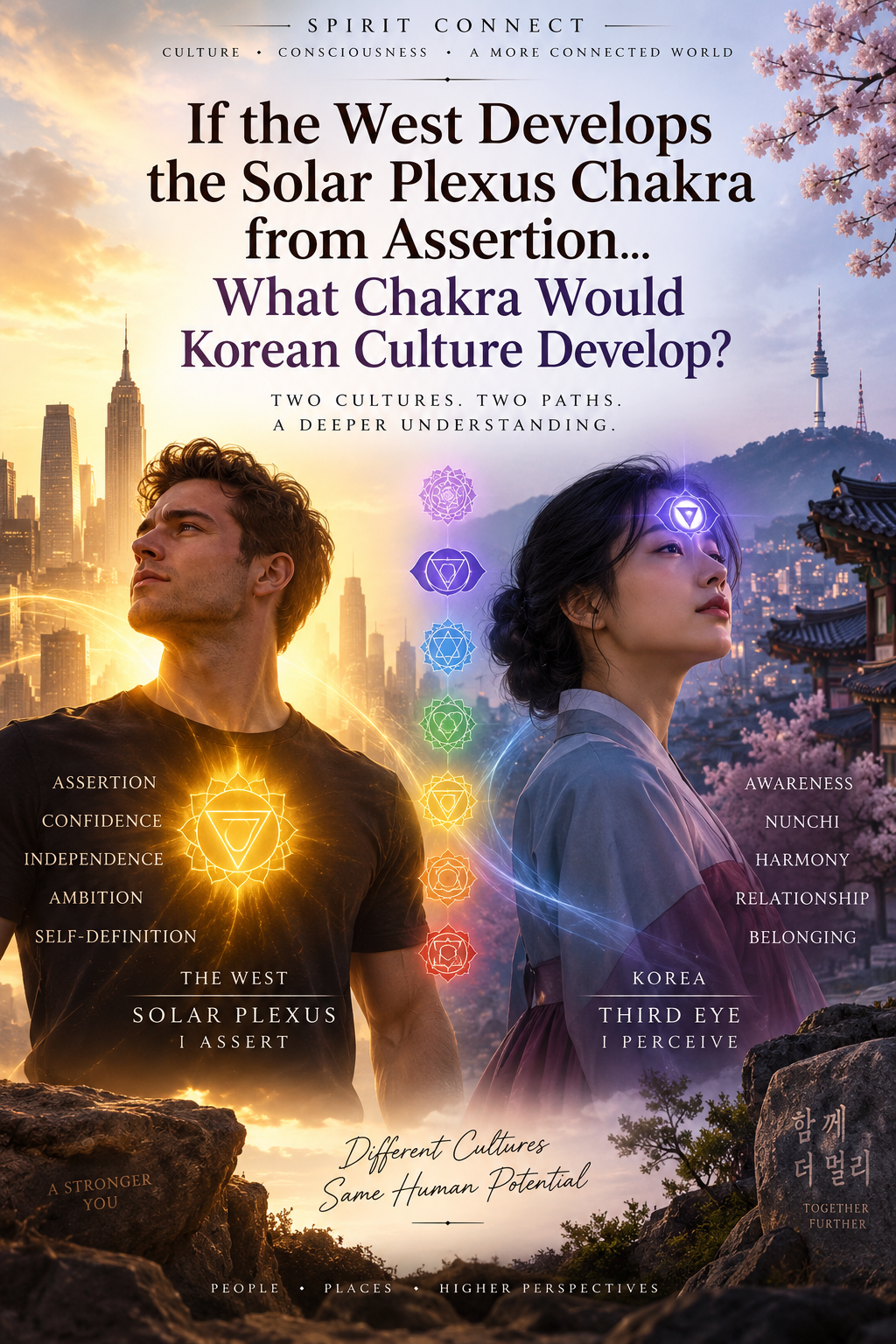
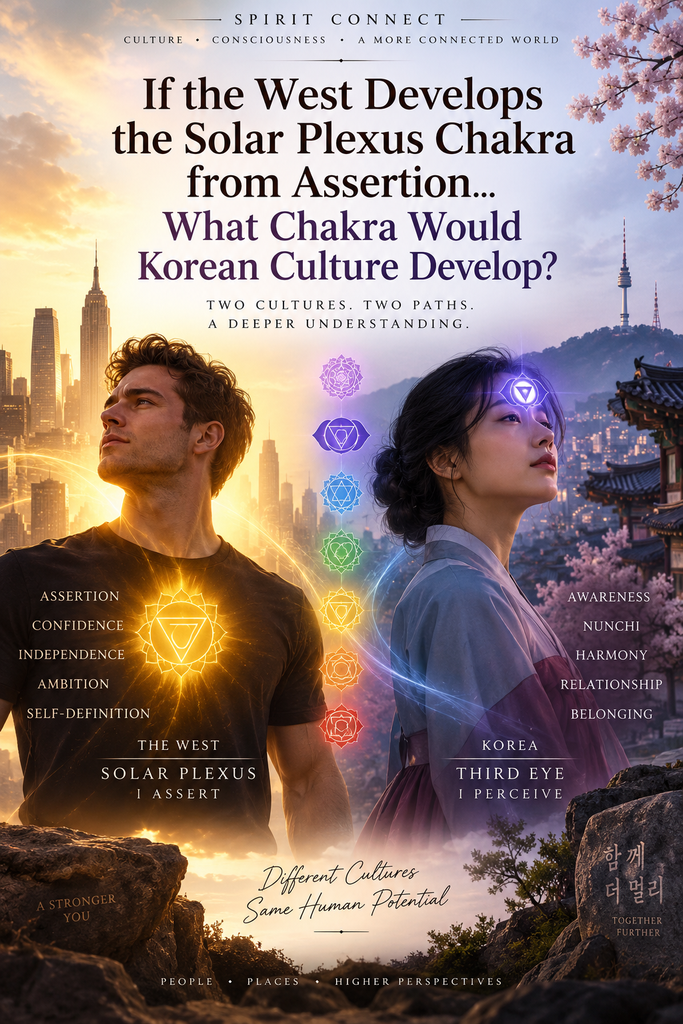
If chakras are used as a symbolic way of understanding culture rather than as scientifically measurable structures, an interesting contrast emerges between modern Western individualism and Korean social culture.
Western societies could reasonably be described as heavily training the solar plexus chakra — Manipura. Korean society, by contrast, seems to place much more cultural training into something resembling the third-eye chakra — Ajna, supported by the heart and root chakras.
The difference is essentially between asserting oneself and reading the field around oneself.
The West and the Solar Plexus
The solar plexus is traditionally associated with willpower, autonomy, confidence, boundaries, ambition, self-definition, and the ability to act upon the world.
These are qualities Western children are often encouraged to develop very early.
Speak up.
Express your opinion.
Stand up for yourself.
Be independent.
Sell yourself.
Tell people what you want.
Develop confidence.
Become a leader.
Even Western conversational culture rewards a certain amount of assertion. People are expected to contribute opinions, tell stories about themselves, promote their achievements, negotiate for better salaries and establish clear personal boundaries.
A person with a weak ability to assert themselves can therefore struggle within Western society.
Symbolically, Western culture repeatedly exercises Manipura.
The message is:
“Know who you are, decide what you want, and project your will into the world.”
Korea Develops a Different Kind of Intelligence
Traditional Korean socialization places far less emphasis on constantly projecting one’s individual will.
Instead, people learn to continuously monitor their relationship to the surrounding group.
Who is older?
Who has higher status?
Who entered the room?
Who should pour the drink?
Is somebody uncomfortable?
Should I speak now?
Would saying this embarrass another person?
What does this person’s expression actually mean?
What is being communicated without being directly stated?
This kind of intelligence is closely related to the Korean concept of nunchi (눈치).
Nunchi is sometimes translated simply as “reading the room,” but that translation understates it. It involves paying attention to subtle social information and rapidly understanding the emotional and relational situation around you.
Through the chakra metaphor, this resembles the function of the third eye.
Korea and the Third Eye Chakra
The third-eye chakra is associated symbolically with perception, intuition, pattern recognition and seeing beneath surface appearances.
A Western social interaction may place emphasis on what a person explicitly says.
A Korean interaction often contains considerably more information in what is not said.
Silence can communicate something.
A slight delay can communicate something.
A person’s choice of speech level communicates something.
Where someone sits can communicate something.
Whether someone pours their own drink or someone else’s can communicate something.
Even small changes in tone can alter the meaning of an interaction.
Consequently, Korean social life trains people to notice contextual information that someone raised in a highly individualistic culture might overlook.
The cultural message becomes something like:
“Before acting, understand the situation around you.”
That is very different from Manipura.
Manipura asks:
What do I want?
Ajna asks:
What is actually happening here?
Nunchi as Social Third-Eye Training
This might explain something foreigners occasionally notice after spending significant time in Korea.
Koreans can sometimes detect interpersonal dynamics remarkably quickly.
Someone may enter a room and immediately sense tension between two people without anyone explaining what happened.
Another person may recognize that somebody wants to leave a conversation despite that person never saying so.
People can adjust their speech, posture or behavior according to subtle changes in the social environment.
A Westerner might interpret this as excessive concern about what other people think.
Sometimes it certainly can become that.
But at its healthiest, it is a sophisticated form of social awareness.
Rather than continually forcing one’s personality outward, attention is partially directed outward toward the entire interpersonal environment.
In chakra language, energy moves from:
“I assert.”
toward:
“I perceive.”
The Heart Chakra Is Also Important
Korean culture also strongly exercises qualities associated with the heart chakra — Anahata.
Korean relationships historically emphasize belonging, loyalty, mutual obligation and attachment to one’s social circle.
Concepts such as jeong (정) illustrate this particularly well.
Jeong describes a form of emotional attachment that gradually develops through shared time, familiarity and mutual experience.
It does not necessarily mean romantic love.
Jeong can develop between friends, neighbors, coworkers, family members or even between people who occasionally irritate one another.
This makes Korean relational culture different from a purely individualistic model.
The relationship itself becomes something almost tangible.
You do not simply ask:
“Do I personally benefit from this relationship?”
There can also be an awareness of:
“We have history together.”
That is strongly heart-centered symbolism.
The Root Chakra Beneath Korean Society
There is another chakra operating underneath both of these: the root chakra — Muladhara.
Traditional Korean society places enormous importance on structure.
Age establishes relationships.
Family establishes identity.
School cohorts establish networks.
Workplace hierarchy establishes roles.
Social rituals establish expectations.
The Korean language itself continually reminds speakers of their relationship to the person they are addressing.
These systems can sometimes feel restrictive, but psychologically they also create social orientation.
You know where you stand.
You know what role you occupy.
You know what behavior is expected.
That resembles the root chakra’s themes of structure, belonging and security.
Therefore a simplified energetic model might look like this:
Western individualist culture: Solar Plexus → assertion → autonomy → personal identity
Korean culture: Root → belonging and structure → Heart → relationship → Third Eye → social perception
The Potential Shadow Side
Every chakra can become overdeveloped or distorted.
Western solar-plexus culture can become narcissistic.
Confidence becomes self-promotion.
Individuality becomes selfishness.
Leadership becomes domination.
Boundaries become isolation.
Likewise, Korean third-eye social sensitivity can become excessive self-monitoring.
Nunchi can turn into anxiety about social judgment.
Awareness of hierarchy can become conformity.
Sensitivity toward others can become fear of standing apart from the group.
The strength and weakness come from the same place.
Western culture can produce someone who says:
“I don’t care what anybody thinks.”
Korean culture can produce someone who thinks:
“I care too much about what everybody thinks.”
Neither extreme is particularly balanced.
Why Koreans Sometimes Notice Things Westerners Miss
This framework may also explain why subtle behavior sometimes carries greater importance in Korea.
A Westerner may believe:
“Nobody said anything, so nothing happened.”
A Korean person may interpret the same situation completely differently because numerous signals were exchanged through context, facial expression, timing, hierarchy and atmosphere.
This is not necessarily because one side is more intelligent.
They have simply practiced different forms of intelligence.
One culture trains the individual to project signals.
The other spends considerably more time training people to receive signals.
One develops the transmitter.
The other develops the antenna.
The Ideal Combination
The most balanced personality would probably combine both systems.
From the West:
Solar plexus
Confidence.
Boundaries.
Independence.
Ability to say no.
Ability to act.
From Korea:
Third eye
Nunchi.
Situational awareness.
Sensitivity to atmosphere.
Understanding what is not explicitly stated.
From both:
Heart
Compassion.
Relationship.
Respect.
And beneath everything:
Root
A stable sense of identity and belonging.
The strongest individual, therefore, would neither constantly impose themselves upon the room nor disappear into the room.
They would be capable of doing something much more difficult:
reading the room clearly while remaining completely centered within themselves.
That might be the real synthesis between Western assertion and Korean social awareness.
The West teaches:
“Find your power.”
Korea teaches:
“Understand the field.”
Wisdom may require both.