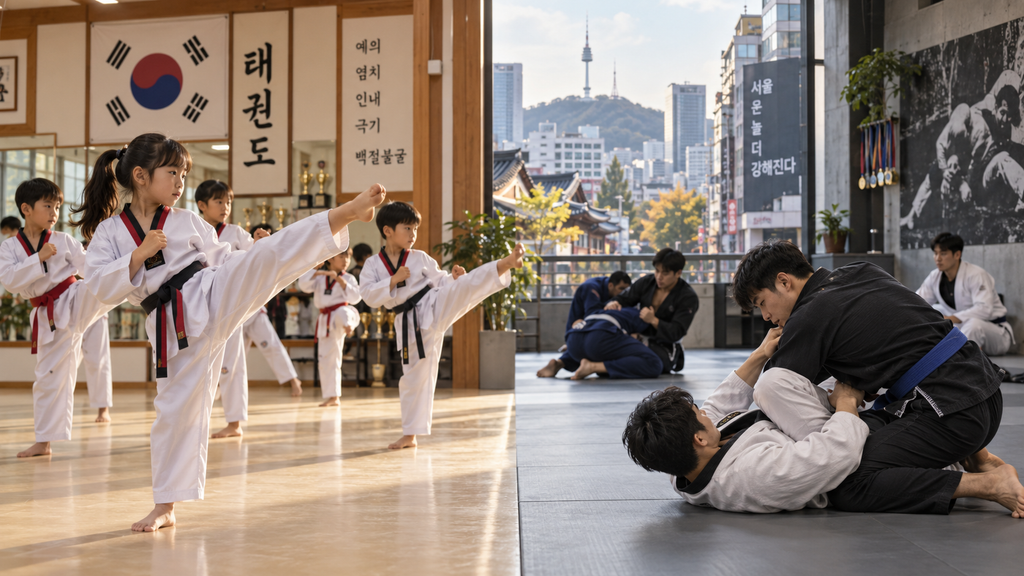
Walk around almost any residential neighborhood in South Korea and sooner or later you will see the familiar sign: 태권도.
Taekwondo schools are everywhere. For generations of Korean children, putting on a white dobok after school has been almost as ordinary as attending an English academy or piano lesson.
But something interesting has happened in Korean martial arts over the last decade.
While taekwondo remains deeply embedded in Korean culture, Brazilian jiu-jitsu—usually simply called 주짓수 (jiujitsu) in Korea—has become increasingly visible, especially among adults and younger Koreans interested in MMA, fitness and practical combat sports.
So has BJJ started replacing taekwondo?
Not exactly.
The more accurate answer is that taekwondo is still enormously important in Korea, but the two martial arts increasingly occupy different cultural spaces.
Taekwondo Is Still Everywhere
It would be difficult to describe taekwondo as disappearing.
At the end of 2025, Kukkiwon listed 9,369 registered taekwondo dojangs within South Korea. Seoul alone had 1,232, while Gyeonggi Province had 2,660. Kukkiwon also recorded millions of domestic poom and dan registrations accumulated through its grading system. Those belt figures are cumulative rather than a count of currently active practitioners, but they illustrate the enormous institutional footprint taekwondo has built in Korea.
Taekwondo also has something BJJ cannot replicate: official national status.
Korean law explicitly states that taekwondo is the national sport of the Republic of Korea. Korea maintains Kukkiwon, Taekwondowon, national promotion programs and government-backed efforts to spread the martial art internationally.
In this sense, BJJ becoming fashionable does not threaten taekwondo’s symbolic position.
Taekwondo is connected with Korea itself.
But there is a catch.
In Korea, Taekwondo Has Become Strongly Associated With Children
One of the strangest things foreigners sometimes discover about Korean taekwondo is that taekwondo can actually feel more like an adult martial art outside Korea than inside Korea.
In Canada or the United States, it is quite normal to see adults starting taekwondo.
In Korea, many neighborhood dojangs primarily cater to elementary-school children.
After school, children are often picked up by taekwondo academy vans, change into uniforms, train, play games, exercise and socialize before returning home. The dojang therefore functions partly as martial-arts school, partly as physical education and sometimes almost as an extension of Korea’s after-school academy system.
This has created a perception problem.
Research into adult taekwondo participation in Korea has repeatedly identified the widespread idea that taekwondo is something people do when they are children. Researchers have also pointed to limited adult class schedules and facilities designed predominantly around younger students as barriers to adult participation.
Even successful adult-focused taekwondo schools in Seoul advertise themselves partly around the fact that adult-only training is unusual compared with the child-centered neighborhood model.
That doesn’t mean Korean adults dislike taekwondo.
Many simply feel they have already done taekwondo.
Someone may have trained for several years as a child, earned a black belt, and then stopped sometime around middle or high school as academic pressures increased.
Taekwondo can therefore occupy an unusual position in Korea: enormously famous, culturally prestigious and widely experienced, while not necessarily being the martial art an adult chooses when deciding to start training at age 25 or 35.
And that creates an opening for BJJ.
BJJ Feels Like an Adult Martial Art
Walk into many Korean BJJ gyms and the atmosphere is noticeably different.
Instead of primarily elementary-school students, you are likely to encounter university students, office workers, military personnel, fitness enthusiasts and MMA fans.
BJJ also arrives without the childhood baggage surrounding Korean taekwondo.
A 30-year-old Korean beginning BJJ does not necessarily feel as though he is joining an activity intended for eight-year-olds. He is entering a combat-sports gym alongside other adults.
There is also another important difference.
BJJ sparring happens constantly.
Rolling allows practitioners to test their techniques against resisting partners at relatively high intensity without repeatedly punching or kicking each other in the head.
That makes progress tangible.
You either escape the position or you don’t.
You either complete the sweep or you don’t.
You either get submitted—or tap your opponent.
That environment fits neatly into the modern fascination with MMA and combat sports.
MMA Helped Change the Korean Martial-Arts Conversation
The rise of UFC and domestic MMA has changed the way martial arts are perceived around the world, and Korea is no exception.
Korean fighters such as Kim Dong-hyun and Jung Chan-sung—the Korean Zombie—helped make MMA familiar to mainstream Korean audiences. Grappling consequently became something ordinary viewers could understand rather than an obscure foreign martial art. Korean media was already describing jiu-jitsu as an essential part of MMA training years ago.
That inevitably benefited Brazilian jiu-jitsu.
A generation that might once have asked:
“Which martial art should I learn?”
can now ask:
“Should I learn striking or grappling?”
From that perspective, taekwondo and BJJ are not even necessarily competitors.
They are complementary.
Taekwondo represents sophisticated kicking and distance management.
BJJ represents clinching, takedowns, positional control and submissions.
MMA made the weaknesses of specializing exclusively in either striking or grappling much more obvious to the public.
The Growth of Korean BJJ Is Now Hard to Ignore
The growth is more than anecdotal.
When the IBJJF Seoul International Open returned to Korea in August 2026 after a seven-year absence, the tournament attracted more than 1,000 competitors from approximately 200 teams and 23 countries.
According to organizers, participation had grown to more than three times the level of the 2019 event. Women’s participation had increased more than threefold and youth participation more than fourfold.
A separate Korean kids’ BJJ championship earlier in 2026 attracted roughly 900 competitors, suggesting BJJ is no longer confined to adult MMA enthusiasts either.
Korea has also become internationally competitive in jiu-jitsu competition. Jiu-jitsu has been an Asian Games medal sport since 2018, and Korean athletes have won Asian Games medals, including gold. The Asian Games version should not be treated as perfectly synonymous with IBJJF Brazilian jiu-jitsu—it uses the international sport jiu-jitsu/Ne-Waza framework—but its visibility has nonetheless helped grappling establish institutional legitimacy in Korea.
So the BJJ boom is real.
But it still hasn’t produced anything resembling taekwondo’s nationwide infrastructure.
Taekwondo’s Bigger Problem May Actually Be Korea’s Birth Rate
BJJ may attract some people who otherwise would have chosen taekwondo.
But ironically, BJJ probably isn’t taekwondo’s greatest threat in Korea.
Demographics are.
For decades, the Korean taekwondo business model has depended heavily on children.
South Korea now has one of the world’s most dramatic declines in its school-age population.
A 2025 Korean academic study examining the sustainability of taekwondo dojangs specifically warned that declining birth rates threaten the traditional youth-centered business model. Among the proposed solutions were adult programs, diversification and turning dojangs into lifelong exercise and community wellness spaces rather than relying primarily on children.
The Korean government appears to recognize the same problem.
Its Fourth Basic Plan for Taekwondo Promotion, covering 2024–2028, explicitly calls for taekwondo that can be practiced throughout a person’s life, with programs aimed at adults and older people as well as children. Government material contrasts the existing youth-centered model with a future model involving multiple generations.
That is an important clue.
Korean taekwondo is not dying.
But the people responsible for its future clearly understand that it cannot remain primarily an elementary-school activity forever.
Ironically, BJJ May Teach Taekwondo Something
BJJ’s success demonstrates that adults will happily dedicate years to martial arts.
They will pay membership fees.
They will compete.
They will travel to tournaments.
They will buy expensive uniforms.
They will train into their 30s, 40s and 50s.
And unlike many childhood martial-arts programs, earning belts in BJJ tends to be deliberately slow. Staying in the martial art for many years becomes part of its culture.
That is precisely the type of lifelong relationship Korean taekwondo organizations increasingly want to rebuild.
Taekwondo arguably doesn’t need to become BJJ.
But it might benefit from recovering more of its identity as something adults actually train, rather than something adults remember doing when they were children.
The Two Martial Arts Attract Different Korean Audiences
The easiest way to understand the situation is something like this:
Taekwondo in Korea is mainstream, institutional and deeply connected with childhood and national culture.
BJJ is smaller, but increasingly fashionable among adults, combat-sports enthusiasts and people looking for an intensive recreational martial art.
Taekwondo has vastly greater cultural recognition.
BJJ arguably has more novelty.
Taekwondo has thousands of neighborhood schools.
BJJ has the appeal of modern fight culture.
Taekwondo is something almost every Korean recognizes immediately.
BJJ is something increasing numbers of Koreans actively choose to pursue as adults.
And there is an important distinction between recognition and participation.
So Is Taekwondo Still Popular in Korea?
Absolutely.
With nearly 9,400 Kukkiwon-registered dojangs as of the end of 2025, Olympic status, enormous institutional backing and legal recognition as Korea’s national sport, taekwondo remains on an entirely different scale from BJJ within Korean society.
But saying simply that “taekwondo is popular” misses what has changed.
Among Korean adults deciding to start a martial art today, taekwondo no longer has the field to itself.
BJJ, boxing, kickboxing, MMA, CrossFit-style training and conventional gyms all compete for the same limited leisure time.
And BJJ has been particularly successful at presenting martial arts as an adult hobby rather than a childhood education program.
That may be the most important shift.
BJJ isn’t replacing taekwondo as Korea’s martial art.
It is challenging taekwondo in an area where taekwondo became surprisingly weak in its own homeland:
convincing adults to keep training.
The future may therefore be less of a battle between BJJ and taekwondo and more of a correction in Korean martial-arts culture.
Taekwondo will probably remain the martial art Koreans grow up knowing.
BJJ is increasingly becoming one of the martial arts Korean adults choose for themselves.
And if Korean taekwondo succeeds in rebuilding a serious adult training culture, the rise of BJJ may ultimately have helped remind Korea that martial arts do not have to end when childhood does.