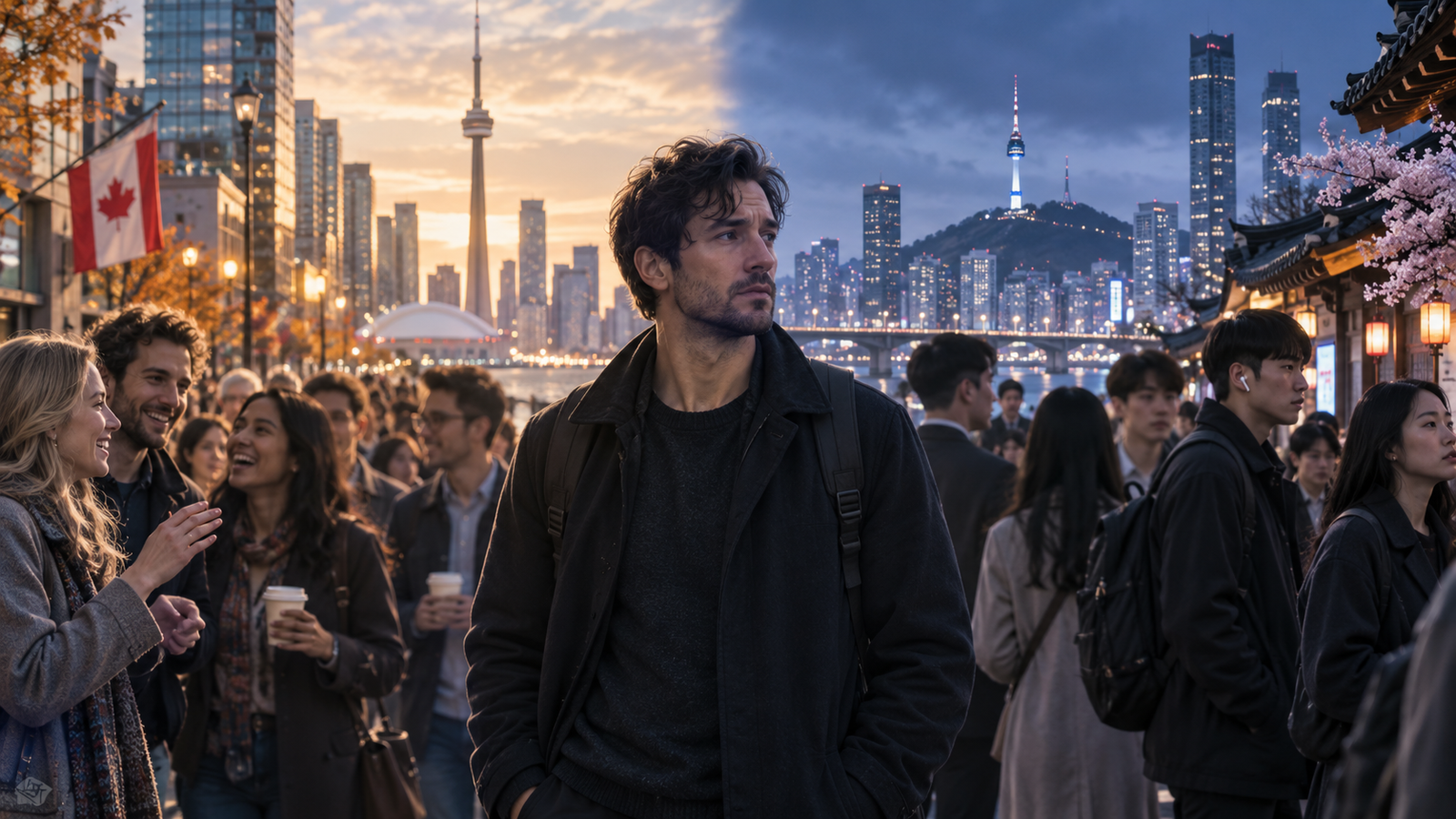
There is a strange paradox at the center of my relationship with Korea.
I am Canadian. I grew up with Canadian culture, and understand its social codes instinctively. Korea, by contrast, is a country where I am visibly and culturally a foreigner.
And yet there have been periods when I have felt more comfortable being a foreigner in Korea than being a Canadian in Canada.
That does not mean I believe I am Korean, nor does it mean that Korean society universally suits me better. In Korea, the fact that I am outside the cultural mainstream is obvious. There is no need to pretend otherwise.
In Canada, the situation can sometimes feel more disorienting.
I am technically an insider, yet increasingly I find myself questioning social behaviours that other people seem to perform automatically. I understand the script, but I do not necessarily want to follow it.
Korea, strangely enough, helped me become comfortable with that.
The Freedom of Being an Obvious Outsider
There can be an unexpected freedom in being foreign.
When I am in Korea, nobody expects me to have exactly the same cultural instincts as a Korean person. There is already an explanation for a certain amount of difference.
I might speak differently. I might interpret a situation differently. I might not understand a hierarchy immediately. I might have different attitudes toward friendship, work, religion or relationships.
There is space between me and the collective.
That space is visible.
In Canada, however, there is an assumption that I should naturally understand and participate in the culture because it is my own.
And I do understand it.
That is precisely why the disconnect can occasionally feel stronger.
I know when I am expected to smile. I know when I am expected to make small talk. I know when I am supposed to soften an opinion. I know when someone says “sorry” even though they are not literally apologizing.
I understand the protocol.
But understanding a protocol and identifying with it are not necessarily the same thing.
Canada Is Individualistic — But It Still Has a Collective Script
Canada is normally described as an individualistic society, especially when compared with Korea.
Broadly speaking, that distinction makes sense. Canadian culture places enormous emphasis on personal choice, independence and the right to construct one’s own identity.
Ironically, that freedom may be partly responsible for my own cultural estrangement.
Canada gave me room to develop independently.
But if you exercise that freedom far enough, eventually you may develop into someone whose assumptions differ significantly from the people around you.
And Canada, despite being individualistic, has its own forms of conformity.
They are simply less explicit.
There is often an expectation of pleasantness. People smile frequently. Conversations are usually kept relatively light unless a deeper relationship has already been established. Disagreement is often wrapped in soft language. People apologize almost reflexively.
The objective is often to prevent the social atmosphere from becoming uncomfortable.
None of this is necessarily bad.
In fact, these conventions can make Canadian society remarkably easy to navigate.
But they are still conventions.
Canada has a collective social language; it just rarely describes itself as having one.
The Canadian Smile as a Social Handshake
One of the clearest examples for me is smiling.
My natural resting expression is fairly serious.
If I am listening carefully to someone, I may become even more serious-looking because I am concentrating.
In Canada, people can occasionally interpret this as anger, intimidation, disapproval or judgment.
Yet I may simply be listening.
In Korea, I have repeatedly felt that a neutral or serious face is less unusual. People often observe each other before displaying warmth. A stranger does not necessarily need to smile continuously in order to communicate that everything is okay.
That suits me.
I sometimes think of the North American smile almost like an old dial-up modem handshake.
For people who never experienced dial-up internet, older modems did not simply connect silently. You would dial into a network and hear a strange sequence of beeps, screeches and electronic noises as the two machines communicated with one another. Before any real information could pass between them, they first had to establish that they could understand each other. That opening exchange was called a handshake.
Social smiling can sometimes feel similar to me.
Before the actual conversation begins, both people exchange a reassuring signal:
“Everything is good. I am friendly. You are friendly. We understand the social rules. We can proceed.”
If one person does not send the expected signal back, the other person may become uncertain.
“Is something wrong?”
“Is he angry?”
“Does she dislike me?”
“Am I making this person uncomfortable?”
The smile is not necessarily fake. Often it is simply a piece of social information being transmitted very quickly.
But in Korea, I often feel there is more tolerance for the connection to remain unconfirmed for a little longer.
Two people can look at each other neutrally.
They can observe.
They can listen.
They can determine who the other person is before displaying familiarity.
The metaphorical connection does not have to make all of its friendly noises immediately.
For someone with a naturally serious face, that seemingly small difference can make everyday interaction feel surprisingly different.
What If I Don’t Want to Smile Yet?
My discomfort is not with smiling itself.
I smile plenty when something actually makes me smile.
What bothers me is the feeling that an expression can sometimes become socially mandatory.
There are moments when I want someone’s face to reflect the gravity of what I am telling them.
If I were talking about something genuinely painful—imagine saying that my dog had just died—and the listener maintained the same cheerful expression they use while ordering coffee, I might begin wondering whether they were actually processing what I was saying.
Of course, people smile for many reasons: nervousness, reassurance, politeness, habit.
But for me, seriousness can itself be a form of respect.
It can mean:
“I am actually listening to you.”
That interpretation of seriousness seems easier for me to inhabit in Korea.
Assuming Familiarity Versus Assuming Distance
Another important difference is how strangers approach familiarity.
In Canada and the United States, speaking to somebody as though you already know them can be interpreted as warmth.
People may joke immediately, use first names, speak casually and establish a temporary sense of equality within seconds.
Korean culture often begins from almost the opposite assumption.
Until the relationship is established, there is distance.
Korean language makes this particularly visible through speech levels, but the principle exists even when the conversation happens entirely in English.
You do not necessarily begin by pretending there is intimacy.
You begin by acknowledging that intimacy has not yet been established.
Oddly, I find something honest about that.
The relationship can warm naturally rather than beginning with the performance of instant familiarity.
Even the Word “Friend” Means Something Different
The same difference appears in friendship.
In Canada, “friend” can mean almost anything.
Someone you met twice can become “my friend.” Someone you had a pleasant conversation with at an event might become “a friend from Meetup.”
Often the word simply means:
“This is somebody with whom I have a positive social relationship.”
Korean friendship traditionally has more defined boundaries, particularly because age and speech level historically matter.
Two people may know each other, like each other and spend time together without necessarily describing one another using precisely the same friendship category that Westerners would.
Again, Korea can be much more collectivist than Canada.
Yet paradoxically, I sometimes find these clearly defined relationship categories easier to understand than the ambiguity of Western informality.
I prefer knowing what something is.
Romance Can Have the Same Difference
I have noticed something similar in attitudes toward relationships.
Western dating culture often celebrates freedom and ambiguity.
People “hang out.”
They “see each other.”
They may avoid defining something because defining it supposedly creates pressure.
Korean dating can certainly be complicated in its own ways, but there is culturally a stronger concept that relationships pass through recognizable stages and eventually receive a name.
That appeals to the part of me that prefers clarity.
The irony is that a supposedly restrictive culture can sometimes feel psychologically clearer than a supposedly free one.
Freedom without definition can occasionally become another form of confusion.
Social Media and the Performance of Connection
This is also one reason I have become less interested in collecting social media contacts simply for the sake of collecting them.
At many North American social events, exchanging Instagram accounts can happen almost automatically.
Sometimes it feels almost like exchanging trading cards.
Follow me. I’ll follow you.
Another connection has been created.
But has a relationship actually been created?
Increasingly, I would rather exchange contact information when there is some real intention behind it—friendship, collaboration, romance, a shared interest or simply a genuine desire to talk again.
That preference can make me appear unusually reserved in environments where networking itself has become part of the social ritual.
But perhaps that is another example of becoming more comfortable with not participating in every available protocol.
Quietness Can Mean Something Different Too
Another contrast I have become increasingly aware of concerns visibility.
In Toronto, particularly around social communities, I have sometimes felt that people need to advertise themselves.
You show what you are doing.
You talk about your projects.
You establish your value.
You make yourself socially visible.
There is nothing uniquely Canadian about this, of course. It is part of contemporary urban culture throughout much of the Western world.
But over time I have become less attracted to it.
I have become more interested in what I think of as quiet shining.
You do not constantly tell people what you are.
You allow them to notice.
Korean culture’s emphasis on modesty can occasionally go too far in the opposite direction, but I find something appealing about the idea that competence does not always need to announce itself.
Sometimes the less I try to establish who I am, the more comfortable I become.
The Paradox of Individualism
This is where the real irony appears.
Korea is routinely described as collectivist.
Canada is routinely described as individualistic.
Yet Korea has sometimes made it easier for me to live as an individual.
Why?
Because nobody there expects me to be Korean.
My separation from the collective is already understood.
Canada says, in theory:
“Be yourself.”
But every society—including Canada—still possesses unwritten expectations regarding how a normal person behaves.
If you continue developing your own worldview long enough, eventually “being yourself” may require violating some of those expectations.
You may stop smiling automatically.
You may stop collecting acquaintances.
You may dislike superficial familiarity.
You may prefer deeper conversations that temporarily disturb the positive atmosphere.
You may stop trying to become the organizer, the loud person or the visible person in the room.
You may simply observe.
At that point, you discover something interesting:
Individualism does not mean there is no collective.
It means the collective is often harder to see.
Korea Did Not Make Me Korean
My connection with Korea therefore does not come from believing that I have somehow become Korean.
If anything, Korea made me more comfortable admitting the opposite.
I am a foreigner there.
That is fine.
There is something psychologically stabilizing about accepting the boundary.
I do not need Korea to validate me by pretending the difference does not exist.
And perhaps that helped me recognize something about Canada.
Being Canadian does not require me to resemble every other Canadian culturally, socially or psychologically.
Canada played an enormous role in creating the person I became.
Its individualism gave me the space to explore different philosophies, cultures and ways of living.
But the final result of that exploration does not necessarily look stereotypically Canadian.
That is not actually a contradiction.
Perhaps it is the logical conclusion of individualism.
Foreign Abroad, Foreign at Home
The strangest feeling is not being foreign.
The strangest feeling is believing that you are supposed to feel at home and discovering that you do not.
A foreign country gives you an explanation.
Different language.
Different history.
Different customs.
Different assumptions.
Feeling culturally distant from your own society is harder to explain because there is no obvious boundary separating you from everyone else.
You can understand every word and still feel that you are speaking a slightly different language.
Korea gave me a way to stop fighting that feeling.
Instead of constantly asking:
“Why don’t I react the way everyone around me seems to react?”
I became more comfortable saying:
“This is simply how I am.”
And perhaps that is the deepest connection I developed with Korea.
It was not that Korea eliminated my sense of being an outsider.
It taught me that being an outsider does not always need to be solved.
Sometimes you simply own it.
And paradoxically, once you stop demanding that every environment make you feel as though you belong, you can begin feeling at home almost anywhere.