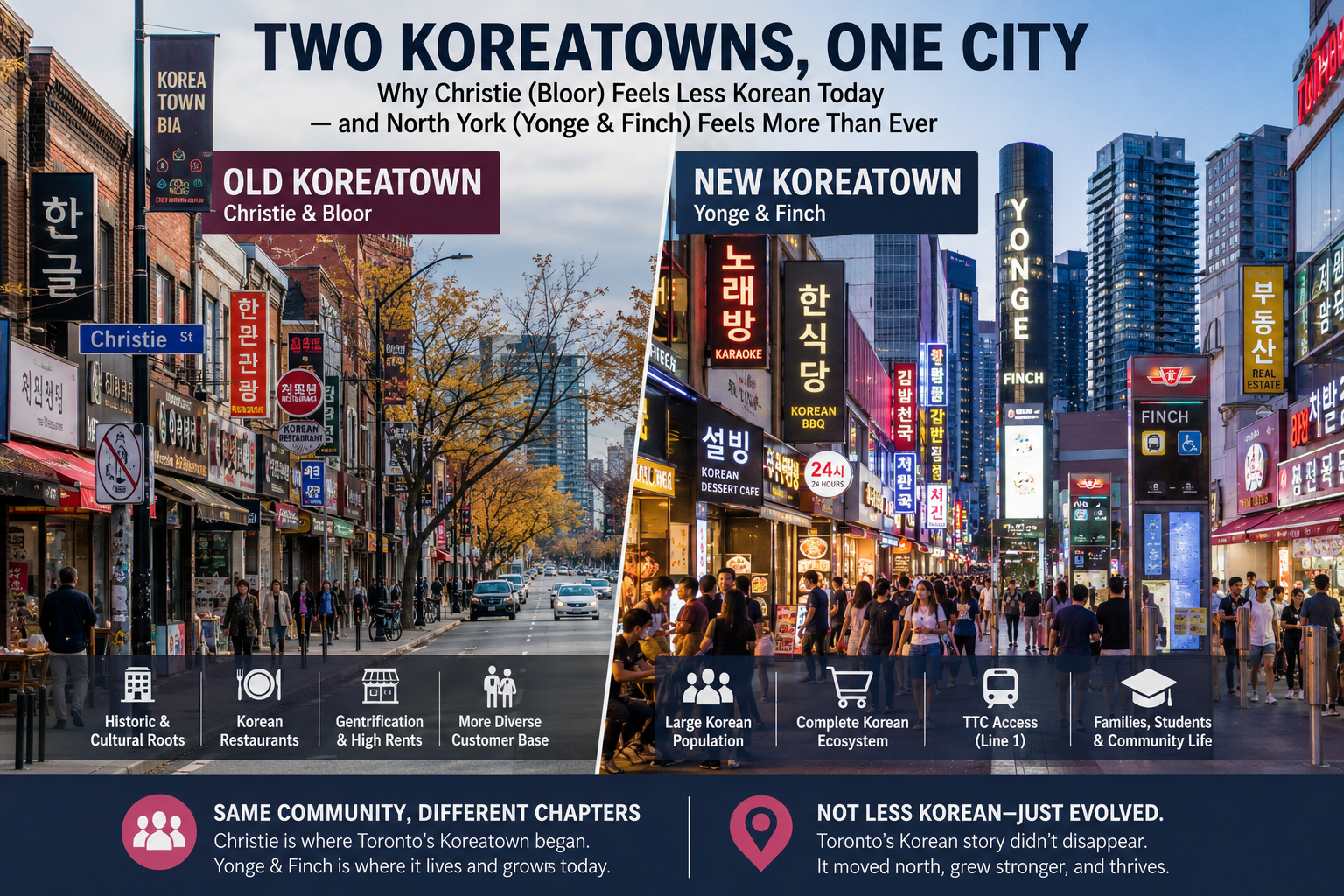


For decades, if someone in Toronto said “Koreatown,” they almost certainly meant the stretch of Bloor Street between Christie and Bathurst.
Today, that answer is more complicated.
Christie Koreatown is still officially Toronto’s Korea Town BIA, and Korean restaurants, supermarkets, beauty businesses and Hangul signs remain part of the neighbourhood. (Toronto) But if you actually want to go somewhere where Korean businesses, Korean residents, Korean students and Korean social life all overlap, North York’s Yonge Street corridor between Sheppard and Finch increasingly feels like Toronto’s real contemporary Koreatown.
It raises an interesting question: how did Toronto’s original Koreatown become less Korean while a new Koreatown emerged farther north?
Christie Was Built by Toronto’s First Major Korean Immigration Wave
Toronto’s Korean community was tiny in the 1960s. That changed after Canada liberalized its immigration system in 1967.
During the late 1960s and particularly the 1970s, thousands of Korean immigrants arrived in Toronto. Many settled around Bloor, Bathurst and Christie, where relatively inexpensive housing and storefronts made it possible for newcomers to establish businesses.
Restaurants came first, followed by grocery stores, bakeries, travel agencies, hair salons, medical services and other businesses catering specifically to Korean immigrants.
By the 1970s, Toronto’s Korean population had grown from roughly 100 people in 1966 to around 10,000, with Bloor Street becoming the community’s most recognizable commercial centre. (Wikipedia)
This was not simply a restaurant district.
It was an immigrant neighbourhood.
The person running the Korean grocery store might live several streets away. Korean churches served local families. Restaurants were feeding Korean customers rather than primarily selling Korean culture to outsiders.
That distinction becomes important when looking at Christie today.
The Korean Population Eventually Moved North
Like many immigrant communities in Toronto, Koreans did not necessarily remain in their original arrival neighbourhood once families became more established.
Beginning particularly in the 1990s, increasing numbers of Korean families began settling in North York, Willowdale, Newtonbrook and eventually Thornhill and Richmond Hill.
Toronto’s second major Korean immigration wave also looked somewhat different from the first. Many newer immigrants arrived with greater financial resources and placed a high priority on home ownership, education and larger suburban housing.
North York offered those things more easily than the increasingly expensive downtown core.
Research into Toronto’s Koreatowns notes that the Korean immigration wave of the 1990s included many wealthier and highly educated immigrants who sought property and good schools, helping establish the Korean community around Sheppard and Finch. (choa magazine)
And where residents go, businesses usually follow.
Yonge Street Became the New Korean Main Street
The result was the gradual development of what is alternately called Koreatown North, New Koreatown or Uptown Koreatown.
Its core runs along Yonge Street roughly between Sheppard Avenue and Finch Avenue, although Korean businesses continue farther north toward Steeles and into Thornhill.
The demographic difference is significant.
According to Toronto’s 2016 Willowdale census profile, 10,470 residents reported Korean as their mother tongue, representing 8.9 percent of the area’s population. (Toronto) Other research has found particularly strong Korean concentrations around the Yonge corridor itself. (Wikipedia)
Meanwhile, remarkably few Koreans actually live around the original Bloor Koreatown today.
That creates the biggest difference between the two areas.
Christie is increasingly a Korean commercial and cultural district. North York is a Korean community as well as a commercial district.
North York Has the Complete Korean Ecosystem
Walk around Yonge and Finch and the Korean presence is difficult to miss.
There are Korean BBQ restaurants, fried chicken restaurants, pocha-style drinking spots, karaoke rooms, cafés, bakeries, hair salons, churches, supermarkets, tutoring services, real-estate businesses and countless smaller Korean-oriented businesses.
The signs themselves sometimes look surprisingly similar to what you might encounter walking through parts of Seoul.
But more importantly, many of these businesses are serving a local Korean population.
That means Koreatown North isn’t dependent entirely on people deciding to make a special trip to “visit Koreatown.”
Someone can live nearby, buy Korean groceries nearby, get a haircut from a Korean-speaking stylist, attend a Korean church, eat Korean food, meet friends for soju and then take the subway home.
That self-contained ecosystem is one reason the area feels more authentically Korean.
The Subway Helped North Koreatown Grow
North York also has something that makes its unusual suburban-urban mixture possible: Line 1 of the TTC.
Finch, North York Centre and Sheppard-Yonge stations connect the entire Korean commercial corridor.
This allows the neighbourhood to combine suburban residential patterns with the pedestrian activity normally associated with downtown Toronto.
Young Korean Canadians and international students can meet around Finch without owning cars. Families farther north in Thornhill or Richmond Hill can drive south. Downtown residents can simply take Line 1 north.
That gives Yonge Street access to several different Korean populations at once.
In many ways, Finch became the gateway connecting Toronto’s urban Korean community with the much larger Korean suburban belt extending north through York Region.
Gentrification Changed Christie Koreatown
At the same time North Koreatown was growing, Bloor Street was undergoing a very different transformation.
Property values increased.
Rents increased.
Condominium development intensified.
The surrounding neighbourhood became more desirable to affluent professionals, students and younger downtown residents.
The closure of Honest Ed’s in 2016 and redevelopment of the massive Mirvish Village site became one of the most visible symbols of the area’s transformation.
Sources documenting the evolution of Koreatown have also pointed to rising rents and gentrification pushing some longtime businesses out of the downtown area. (Foodism CA)
For a Korean immigrant family deciding where to establish a business serving primarily Korean customers, North York increasingly made more sense.
Why pay downtown rents when a substantial portion of your customer base already lives farther north?
Korean Food Became Mainstream — Which Paradoxically Made Christie Less Korean
There is another factor that sounds contradictory.
Korean culture becoming more popular actually helped make old Koreatown feel less exclusively Korean.
Twenty or thirty years ago, someone visiting a Korean restaurant on Bloor might have been Korean, accompanying Korean friends or deliberately seeking an unfamiliar cuisine.
Today, Korean fried chicken, barbecue, bibimbap, soju and Korean cafés are mainstream parts of Toronto food culture.
K-pop and Korean dramas have created another enormous audience for Korean culture.
So Bloor Koreatown no longer needs a predominantly Korean customer base to survive.
Restaurants increasingly serve Chinese, Japanese, European, South Asian, Middle Eastern, Latin American and other Torontonians.
One longtime Koreatown restaurateur told Foodism that he had seen progressively fewer Korean customers and more non-Korean customers as Korean cuisine became more popular. (Foodism CA)
That is not necessarily a decline.
In another sense, it represents Korean culture becoming successfully integrated into Toronto.
But it changes the feeling of the neighbourhood.
Christie Has Become Something Closer to a Heritage Koreatown
This is perhaps the best way to understand the difference.
Christie is Toronto’s historic Koreatown.
North York is Toronto’s living Koreatown.
That doesn’t make Bloor Koreatown fake or irrelevant.
Far from it.
Christie remains enormously important to Korean-Canadian history. The Korean businesses, institutions and families that established themselves there helped build Toronto’s Korean community long before K-pop, Korean fried chicken or Korean beauty products had mainstream recognition in Canada.
Its cultural importance therefore may actually increase as its demographic role decreases.
It is becoming somewhat comparable to the old ethnic neighbourhoods found throughout major North American cities: the community moves elsewhere, but the original neighbourhood remains a symbolic homeland.
Toronto’s Korean Community Didn’t Disappear — It Migrated
Looking only at Christie could therefore create the mistaken impression that Toronto’s Korean community has declined.
The opposite is closer to reality.
The 2021 census counted more than 74,000 people identifying as Korean in the Toronto metropolitan area. (Statistics Canada)
What changed was geography.
The community spread north.
First into North York.
Then into areas around Steeles.
Then Thornhill, Richmond Hill and other parts of York Region.
This is similar to what happened with several other Toronto immigrant communities. The first generation establishes an inner-city enclave because it provides affordable housing, employment and community connections. As families become established and new immigration waves arrive, population centres move toward areas offering larger homes, schools and newer commercial spaces.
The original enclave remains behind as a cultural landmark.
Old Koreatown and New Koreatown Now Serve Different Purposes
That is why visiting the two areas today produces such different experiences.
Around Christie and Bloor, you are visiting an established Toronto neighbourhood that happens to contain an important Korean cultural district. Korean restaurants sit beside businesses representing countless other cultures, while much of the clientele comes from across the city.
Around Yonge and Finch, the Korean presence feels more embedded in everyday neighbourhood life.
You hear Korean walking down the street.
Businesses advertise directly in Hangul.
Restaurants stay busy late into the evening.
Karaoke, cafés, Korean fried chicken and drinking culture overlap within a relatively small area.
And the people using those businesses are often people who actually live nearby.
That makes North York feel considerably closer to the experience of a genuine modern Korean urban district.
Christie Is the Past — North York Is the Present
Calling Christie Koreatown “less Korean” shouldn’t be interpreted as saying it has lost its value.
It has simply entered a different stage of its history.
Christie tells the story of how Koreans first established themselves in Toronto.
Yonge and Finch tells the story of what happened after they became established.
One represents immigration, settlement and the first generation of Korean Toronto.
The other reflects a larger, wealthier, more geographically dispersed and more deeply established Korean-Canadian community.
And perhaps that is the most interesting thing about Toronto’s two Koreatowns.
They aren’t really competitors.
Together, they tell two chapters of the same immigrant story.
Bloor and Christie is where Toronto’s Koreatown began.
Yonge and Finch is where much of Korean Toronto went next.